
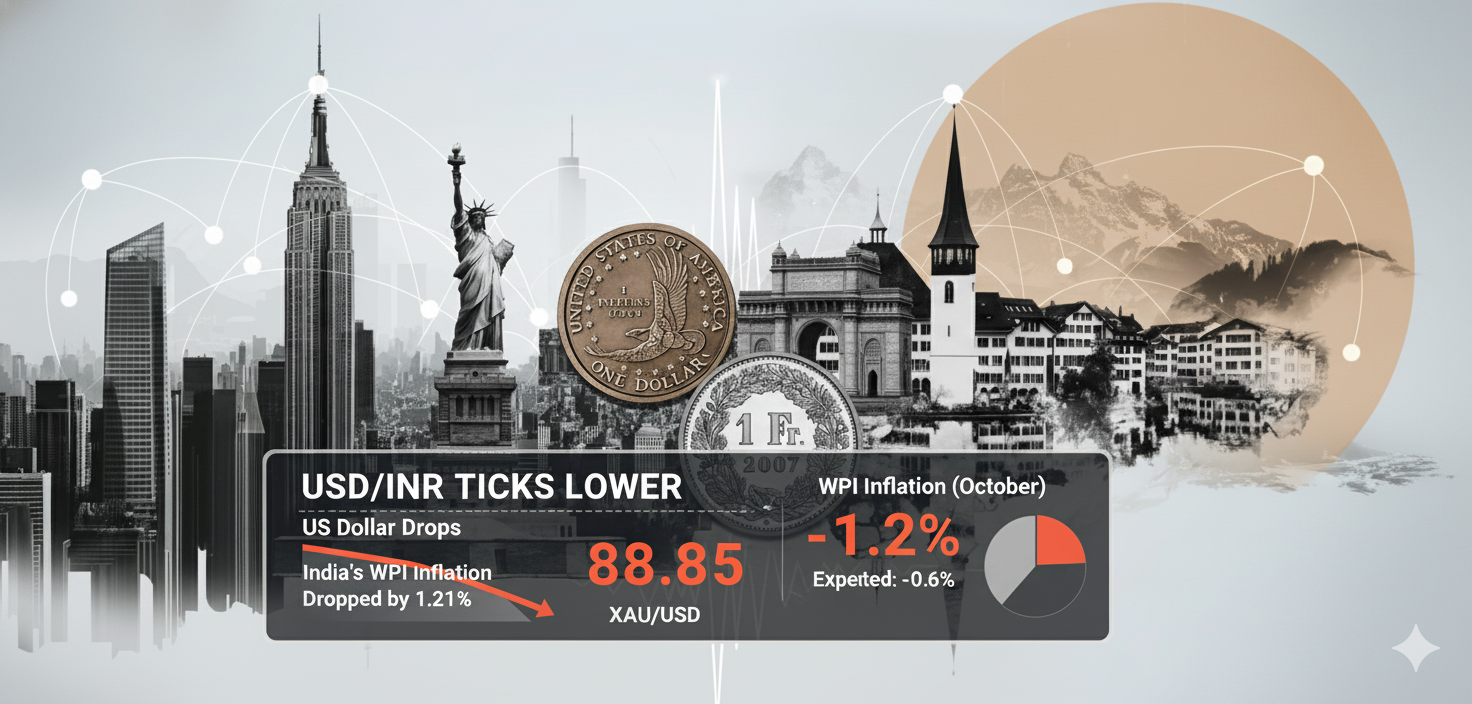
The Indian Rupee (INR) showed a slight uptick against the US Dollar (USD) at the market open on Friday. The USD/INR pair edged lower to approximately 88.85 as the US Dollar continued its decline. Despite this marginal gain for the Indian Rupee, it remains largely under pressure, nearing its all-time high of 89.10, primarily due to the ongoing failure of the United States (US) and India to finalize a trade deal.
To bolster the Indian Rupee, the Reserve Bank of India (RBI) has intervened multiple times since August, when US-India trade tensions began. A Reuters report indicates that the RBI is likely to sell US Dollars to prevent the Indian Rupee from falling below its record low.
In the absence of a US-India trade agreement, overseas investors have consistently reduced their stakes in the Indian stock market. On Thursday, Foreign Institutional Investors (FIIs) were net sellers for the fourth consecutive trading day, divesting shares worth Rs. 383.68 crore.
Domestically, India’s Ministry of Commerce and Industry released October’s Wholesale Price Index (WPI) Inflation data, which revealed a faster-than-expected annualized decline of 1.21% in wholesale inflation. Economists had anticipated a drop of 0.6%, following a 0.13% increase in September.
This softer producer inflation data is expected to fuel speculation of an interest rate cut by the Reserve Bank of India (RBI) during its December monetary policy announcement.
Speculation surrounding an RBI interest rate cut in December had already intensified earlier this week following the release of October’s Consumer Price Index (CPI) data, which indicated a moderate annualized inflationary pressure of 0.25%.
Daily Digest Market Movers: Fed Dovish Bets Recede Amid Upside Inflation Risks
The slight downward movement in the USD/INR pair is predominantly driven by weakness in the US Dollar. At the time of reporting, the US Dollar Index (DXY), which tracks the Greenback’s value against six major currencies, was marginally lower, trading near 99.15. The DXY remains close to its two-week low of 99.00, recorded on Thursday.
The US Dollar has faced pressure as investors anticipate that the forthcoming US economic data releases, which were delayed due to the government shutdown, will reveal further economic weakness.
Analysts at Commonwealth Bank of Australia commented, as reported by Reuters, “Starting from next week, we’re going to get a lot of economic data from the U.S., and we think it’s going to be pretty bad. I think that the market is now preparing for the coming deluge of poor U.S. economic data.”
Signs of an economic slowdown in the US economy would increase expectations for an interest rate cut by the Federal Reserve (Fed) at its December meeting. These expectations had previously eased on Thursday after several policymakers highlighted upside inflation risks.
According to the CME FedWatch tool, the probability of the Fed cutting interest rates by 25 basis points (bps) to 3.50%-3.75% in the December meeting has decreased to 50.7%, down from 63% on Thursday.
St. Louis Fed Bank President Alberto Musalem and Cleveland Fed Bank President Beth Hammack both advocated for a cautious monetary policy approach, emphasizing the need to address inflation that remains above target.
As Hammack stated in a fireside chat at the Economic Club of Pittsburgh on Thursday, “Employment side of Fed mandate challenged amid job market softening, but the Fed needs to maintain some amount of policy restriction to cool inflation.”
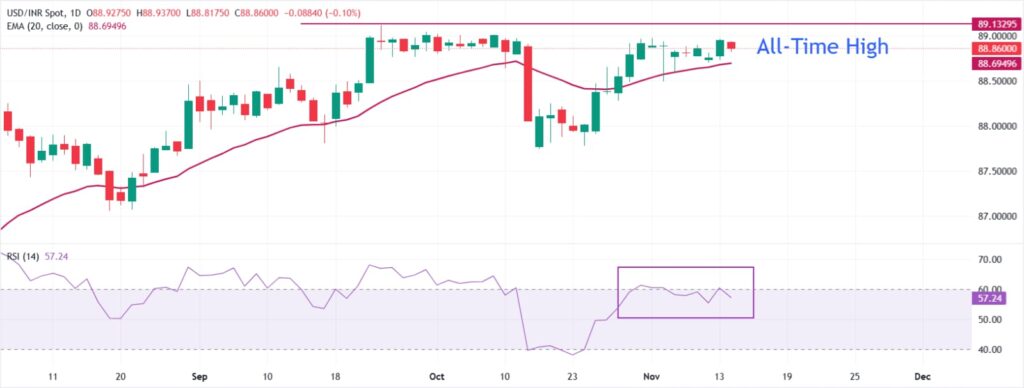
The USD/INR pair is experiencing a marginal decline, trading near 88.85 at Friday’s open. However, its near-term trend retains a bullish bias, as the pair remains above its 20-day Exponential Moving Average (EMA), which is currently at approximately 88.69.
The 14-day Relative Strength Index (RSI) is attempting to move back above the 60.00 threshold. Should the RSI (14) successfully achieve this, it would signal the emergence of fresh bullish momentum.
Looking to the downside, the August 21 low of 87.07 is poised to act as a critical support level for the pair. Conversely, on the upside, the all-time high of 89.12 will present a significant resistance barrier.