

Gold (XAU/USD) is attracting sellers, dropping to a fresh daily low during the early European session on Friday after an earlier intraday push above the $4,200 mark. This decline comes as a growing number of Federal Reserve (Fed) policymakers have signaled caution regarding further monetary easing due to a lack of economic data. Consequently, traders are reducing their expectations for another rate cut in December, creating a significant headwind for the non-yielding yellow metal.
Despite this, investors appear convinced that the weakening economic momentum resulting from a prolonged US government shutdown will eventually compel the Fed to ease monetary policy further. This sentiment is keeping the US Dollar (USD) depressed near a two-week low, reached on Thursday, which could provide underlying support for Gold prices. Additionally, a generally risk-off market mood might help limit further downside for the safe-haven precious metal, urging caution among bearish traders.
Daily Digest Market Movers: Gold Dips as Traders Scale Back December Fed Rate Cut Bets With the reopening of the US government, market attention is shifting back to the deteriorating fiscal outlook. Moreover, market participants now widely anticipate that the delayed US macroeconomic data will reveal economic weakness, bolstering the argument for further policy easing by the US Federal Reserve.
Economists estimate that the extended government shutdown may have already shaved approximately 1.5 to 2.0% off quarterly GDP growth. This situation, coupled with signs of a weakening labor market, is hindering the US Dollar’s ability to recover from its two-week low.
Meanwhile, a senior White House official indicated that key economic reports for October, including employment details and inflation data, might not be released at all. This uncertainty has prompted several Fed officials to express caution about further easing, leading investors to trim their expectations for a December rate cut.
Minneapolis Fed President Neel Kashkari noted that the economic outlook remains mixed due to persistent high inflation. Separately, Boston Fed President Susan Collins stated that given the limited inflation information resulting from the government shutdown, she would be hesitant to ease policy further.
Despite these cautious remarks, the CME Group’s FedWatch Tool shows traders still pricing in a 50% probability that the US central bank will lower borrowing costs by 25 basis points in December. Furthermore, the probability of a rate reduction in January currently exceeds 75%, which is generally favorable for XAU/USD bulls.
Traders are expected to continue closely monitoring comments from influential Federal Open Market Committee (FOMC) members for additional clues regarding the Fed’s rate-cut trajectory. These insights will, in turn, influence USD demand and provide impetus to the non-yielding yellow metal, which appears poised to conclude the week with substantial gains.
Gold Must Surpass $4,200 for Further Near-Term Gains
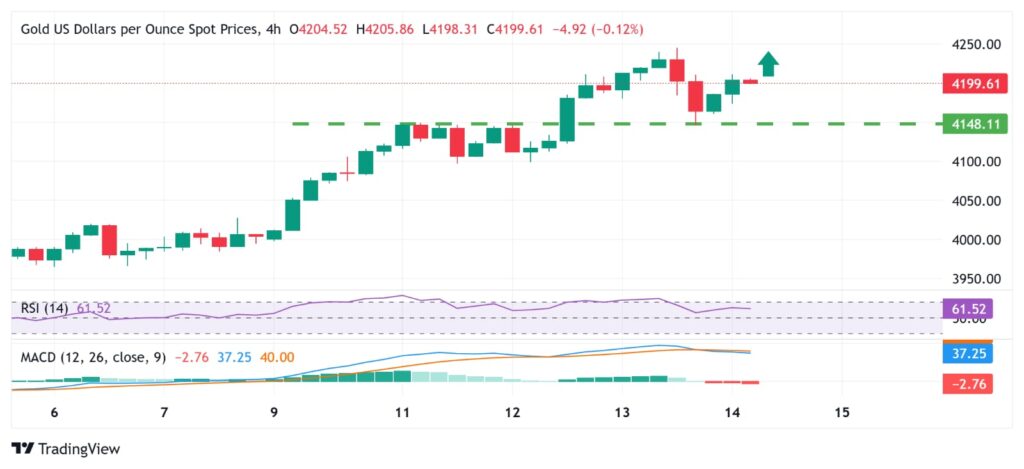
This week’s decisive breach of the $4,150 horizontal resistance, followed by a move beyond the $4,200 mark, was a significant catalyst for XAU/USD bulls. Furthermore, oscillators on both daily and 4-hour charts have been showing positive momentum, indicating that Gold’s price is biased to the upside. Any continued ascent, however, may encounter resistance near the overnight swing high, around the $4,245 area. A sustained break above this point could see the commodity target a reclaim of the $4,300 round figure.
Conversely, the immediate downside now appears to be protected by the overnight swing low, located around the $4,145 region. A convincing break below this level could accelerate Gold’s decline towards the $4,100 mark, potentially extending to the $4,075 zone. Further selling pressure might expose the $4,025 intermediate support before the commodity eventually falls to the psychological $4,000 mark. The $4,000 level is likely to serve as a critical pivot point; a decisive breach below it could shift the near-term bias in favor of bearish traders.