

During Tuesday’s Asian session, the Japanese Yen (JPY) stayed on the defensive due to concerns regarding Japan’s fiscal stability, driven by Prime Minister Sanae Takaichi’s plans for aggressive spending and tax cuts. Additionally, political uncertainty ahead of the February 8 snap election and a generally positive global risk tone are undermining the safe-haven currency. A modest recovery in the US Dollar (USD) has helped USD/JPY move off Monday’s multi-month lows.
Fiscal Concerns Outweigh Hawkish Signals Investors are hesitant to buy the Yen as Japan’s strained public finances face scrutiny. PM Takaichi’s campaign pledge to suspend the sales tax on food has heightened fiscal anxiety, causing long-dated Japanese government bond (JGB) yields to surge recently. This increases debt servicing costs and limits the Yen’s upside potential.
Recent data showed Japanese wholesale inflation (PPI) slowed to 2.4% YoY in December. However, this does not contradict the Bank of Japan’s (BoJ) trajectory. The BoJ recently raised its economic forecasts and signaled a readiness to continue hiking interest rates, creating a significant divergence from the dovish expectations surrounding the US Federal Reserve.
Intervention Threats and Fed Meeting in Focus Despite the fiscal gloom, JPY bears remain cautious due to the BoJ’s hawkish stance and speculation of government intervention. PM Takaichi warned Sunday that officials are ready to act against speculative market moves, following recent rate checks by the Ministry of Finance and the New York Fed.
Simultaneously, the USD is struggling to gain momentum as markets expect the Fed to cut rates twice more this year. Consequently, traders are reluctant to place large bets ahead of the crucial two-day FOMC meeting starting today, the outcome of which will determine near-term direction for the USD/JPY pair.
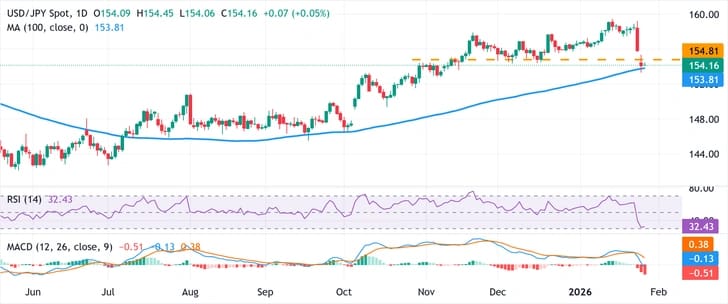
On Monday, the USD/JPY pair demonstrated resilience beneath the 100-day Simple Moving Average (SMA), although it continues to trade below the significant former support zone of 154.75-154.80. Technical momentum remains negative, indicated by the MACD histogram extending deeper into negative territory, confirming the MACD line is below the Signal line. Meanwhile, the Relative Strength Index (RSI) is hovering at 32, just shy of oversold territory, suggesting recent selling pressure may be stretched.
The immediate focus is the 100-day SMA at 153.81. A definitive daily close below this level would hand greater control to bears. Conversely, sustained trading above this rising SMA would keep the broader bullish anchor intact. Looking ahead, signs of momentum stabilization would include a flattening MACD histogram moving toward zero and an RSI recovery toward the 50 mark. However, if the RSI drops below 30, it risks triggering further weakness.