

Gold (XAU/USD) prices are pushing back toward the all-time high above $5,100 on Tuesday, attracting fresh buying interest after a brief pullback during the previous session. This marks the seventh consecutive day of gains for the precious metal, supported by a confluence of factors including a struggling US Dollar, geopolitical instability, and expectations of a dovish Federal Reserve.
Key Drivers: A Weaker Dollar and Trump’s Trade Policies The US Dollar is hovering near its lowest levels since September 2025, struggling to gain traction amid policy shocks from the Trump administration. Concerns over global trade have intensified following President Trump’s threat on Saturday to impose a 100% tariff on Canada regarding its trade dealings with China—a move that follows a recently withdrawn tariff threat concerning Greenland. These policy uncertainties have tarnished the Dollar’s standing in global markets.
Furthermore, the non-yielding metal is benefiting from market expectations that the Federal Reserve will continue to lower borrowing costs. Bets on two additional rate cuts this year helped drag the USD to a four-month low on Monday, acting as a significant tailwind for Gold prices.
Geopolitical Tensions and the “Flight to Safety” Persistent geopolitical risks continue to underpin Gold’s role as a safe-haven asset. The protracted war between Russia and Ukraine remains a major concern, especially after US-brokered peace talks in Abu Dhabi ended without an agreement on Saturday. Ukraine flatly rejected Russia’s demand to cede the entire Donbas region to end the conflict.
Market Caution Ahead of Fed Decision Despite the strong bullish fundamentals, XAU/USD traders may pause buying ahead of the critical two-day FOMC meeting concluding on Wednesday. Investors are awaiting clarity on the Fed’s rate cut path, and Fed Chair Jerome Powell’s post-meeting remarks could inject volatility into the markets.
Strong Underlying Demand from Central Banks and ETFs The fundamental backdrop for bullion remains robust due to sustained physical demand. Central banks have been active buyers; the People’s Bank of China (PBOC) extended its buying spree for a fourteenth month in December, joining central banks from Poland, India, and Brazil in recent accumulation.
Investment demand is also surging. Global gold ETF holdings jumped by 25% in 2025, rising from 3,224.2 tonnes to a record 4,025.4 tonnes, with total Assets Under Management reaching $558.9 billion. Technically, Gold retains a bullish bias as it continues to trade within an ascending trend channel.
On the economic data front, the US Census Bureau reported a surprising 5.3% jump in Durable Goods Orders for November on Monday, significantly beating expectations of 0.5% growth.
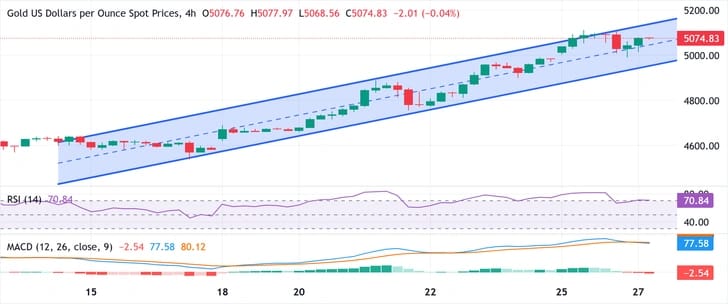
The overnight failure to break out of a short-term ascending channel, followed by a pullback, may be an initial sign of bullish exhaustion. However, the emergence of fresh buying on Tuesday warrants caution before confirming that Gold prices have peaked. The broader uptrend remains underpinned by the ascending channel, with the lower boundary providing support near $4,971.48 as the XAU/USD pair holds mid-range.
Momentum indicators are showing signs of rolling over; the MACD histogram has flipped negative and is widening, indicating the MACD line has slipped below the Signal line near the zero level. The Relative Strength Index (RSI) is overbought at 70.84 and easing, suggesting buyers may remain cautious while the pair consolidates within the channel. On the upside, advances are capped by the upper channel boundary at $5,156.89. A recovery in the MACD toward a bullish crossover is needed to reassert upward traction, while the elevated RSI argues for price digestion before a sustained break. A 4-hour close above this cap would open the path to extend the uptrend, whereas a failure to improve momentum leaves the bias vulnerable to further tests of the channel floor