InstantXRP Overview: DeFi on Top of the XRP Ecosystem
What Is InstantXRP and What Is Its Goal?
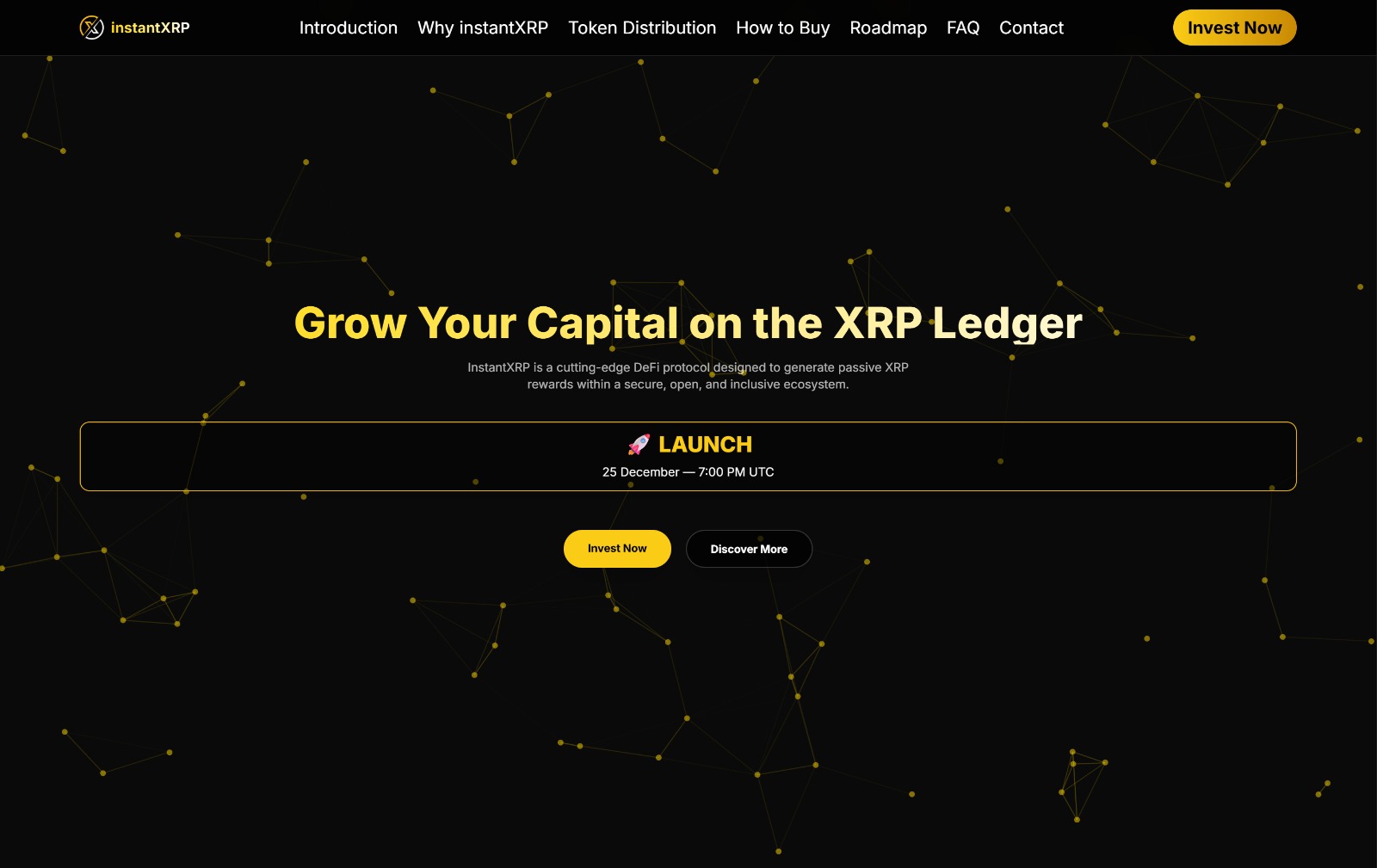
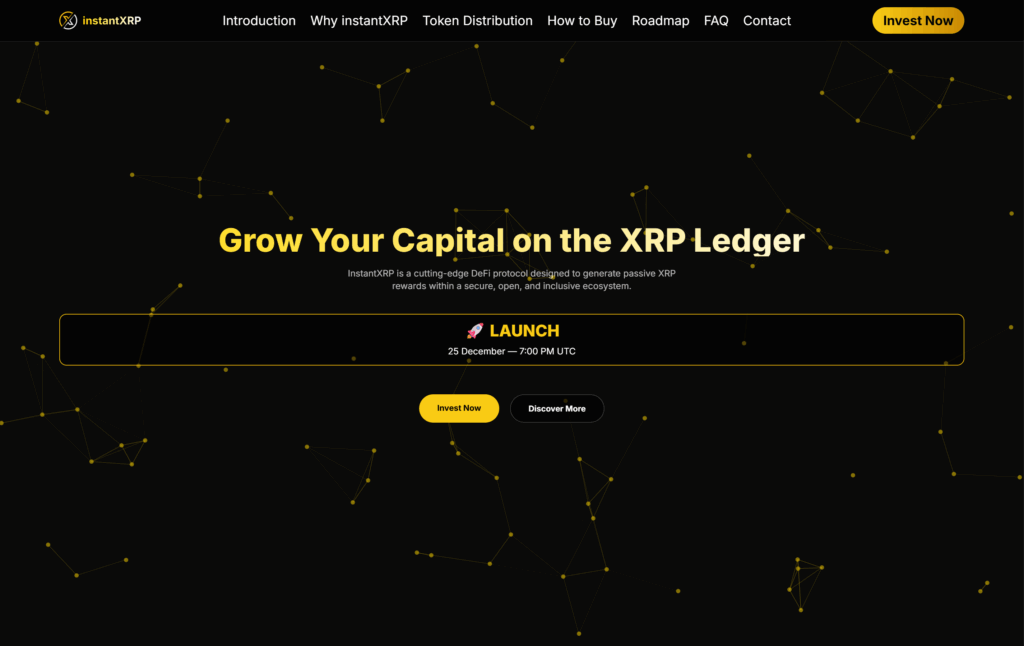
InstantXRP is a DeFi protocol designed to give passive income to holders through rewards paid in XRP. On its official site, the team describes InstantXRP as a modern “XRP rewards engine”: a token where a portion of every transaction is redistributed back to token holders in the form of XRP automatically.
The token contract reviewed here uses the address:0x4D31CD5cD3305ce2D9e9040DBDdF9258dfb2817e and runs on the BNB Smart Chain (BSC) as a BEP-20 token with the same name and symbol: INSTANTXRP.
The project positions itself as a bridge between the XRP Ledger ecosystem (known for speed and low fees) and EVM-based DeFi such as BSC. On the main page, InstantXRP emphasizes:
- A focus on XRP passive rewards
- An ecosystem that is “safe, open, and inclusive”
- Plans to expand the ecosystem (InstantADA, InstantSOL, and a virtual card)
Network Used: BSC + Focus on the XRP Ledger
Even though the tagline is “The Future of DeFi on XRP Ledger,” the token implementation we’re reviewing currently lives on BSC, not natively on the XRP Ledger. The smart contract is written in Solidity, uses compiler 0.8.4, and is licensed under MIT.
In practice, the concept looks like this:
- The INSTANTXRP token lives on BSC (easy to access via MetaMask, Trust Wallet, and so on).
- The rewards promised to holders are paid in XRP, so the project leverages XRP’s popularity as the main asset for investors.
Here, investors need to understand that “DeFi on XRP Ledger” is more of a positioning and long-term vision, not a reflection that the current contract is already running directly on the XRP Ledger.
How InstantXRP Works and Its XRP Passive Income Mechanism
5% XRP Reward Scheme for Holders
One of InstantXRP’s main selling points is the claim that 5% of every transaction (buy/sell) is redistributed back to holders as XRP rewards.
From the documentation on the website and the BlockSAFU audit, the mechanism can be summarized as:
- Every time there’s a buy or sell transaction:
- 5% is allocated as rewards to holders (XRP rewards).
- These rewards are distributed automatically, so holders only need to keep InstantXRP in their wallet to receive them.
This concept is similar to many other reflection or reward tokens on BSC, but here the emphasis is on paying rewards in XRP instead of the token itself.
Transaction Fees and Their Impact on Investors
Based on the BlockSAFU audit report, InstantXRP’s transaction tax structure is as follows:
- Buy Tax – Total 8%
- 5% for rewards to holders
- 2% for marketing
- 1% for the liquidity pool
- Sell Tax – Total 8%
- Same structure: 5% rewards, 2% marketing, 1% liquidity
- Wallet-to-Wallet Transfers (not buy/sell on a DEX)
- 0% tax – there’s no fee when simply sending tokens between wallets.
From an investor’s point of view:
- An 8% tax is quite high if you’re a short-term trader, because every time you enter and exit a position you lose a relatively large percentage to tax.
- For medium- to long-term holders, this tax can be seen as the “cost” of receiving passive XRP rewards and supporting marketing plus liquidity.
A side note: PancakeSwap currently labels this token as “High Risk” via its HashDit / RedAlarm integration for the INSTANTXRP token output, which usually means the contract is relatively new, liquidity is still small, or the contract triggers certain risk flags. This doesn’t equal “scam,” but it does mean the token carries high risk according to that system.
InstantXRP Tokenomics: Taxes, Distribution, and Holders
Buy/Sell Tax Structure and 0% Transfers
BlockSAFU notes that the tax functions in the InstantXRP contract support allocations to marketing, liquidity, and holder rewards, with a total of 8% on each buy/sell transaction and 0% for regular transfers.
In addition, the total supply recorded is 100,000,000 INSTANTXRP with 18 decimals.
The combination of a capped supply and reward taxes is designed to:
- Attract long-term holders (the longer you hold, the more chance you have to earn rewards).
- Support liquidity through a 1% allocation to the LP on every transaction.
However, how effective this strategy is will depend heavily on trading volume and market interest in the token.
Holder Concentration and Its Implications
A key part of tokenomics that new investors often overlook is the distribution of ownership. Data from the BlockSAFU audit shows:
- The top 1 wallet holds about 51.48% of the supply.
- The top 2 wallet holds about 48.52% of the supply.
In other words, at the time of the audit, nearly 100% of the total supply sat in just two wallet addresses. This very strongly indicates that:
- The token is still at a very early stage (no broad distribution to the public yet).
- There’s a major centralization risk: if one of these wallets sells a large amount, the price could crash dramatically.
For a project that claims DeFi and passive rewards, this degree of concentration needs to be monitored over time—does the distribution become more even after the fairlaunch and listing, or does it stay concentrated in a few big wallets?
BlockSAFU Security Audit for InstantXRP
Audit Summary & Trust Score
InstantXRP has been audited by BlockSAFU with the following key details:
- Audit Date: 22 November 2025
- Network: BSC
- Audit Status: Passed
- Trust Score: A – categorized as “Excellent / Very Secure” on BlockSAFU’s internal scale
- Code Review:
- 0 Critical
- 0 Major
- 0 Medium
- 0 Minor
- 2 Informational
This means that, from the standpoint of the smart contract’s structure:
- No critical, major, medium, or minor vulnerabilities were found at the time of the audit.
- The two issues identified are informational only, not high-level security bugs.
However, it’s very important to remember: BlockSAFU itself clearly states that an audit does not guarantee absolute security or profitability of a project, and that investors must still conduct their own research.
Informational Issues: Set Fees & Whitelist
In the Issue Tags section, BlockSAFU flags two features of the InstantXRP contract:
- Set Fees – the contract contains functionality to change the tax/fee structure.
- Whitelist – there’s a whitelist mechanism in the contract.
What this implies:
- The team has certain control over the fee size (as long as it’s not renounced/locked).
- The whitelist function can be used, for example, to exclude certain addresses from tax or, in some contracts, to restrict who’s allowed to trade.
This doesn’t automatically mean the project is a scam, but:
- Investors should monitor whether these functions are used reasonably.
- Ideally, the team provides thorough documentation and transparency about how and when these functions will be used.
Fairlaunch, PinkSale, and Launch Details
PinkSale Bot and the fairlaunch page record several important details about InstantXRP’s launch:
- Method: Fairlaunch on PinkSale (BSC).
- Fairlaunch Period: 28 November – 8 December (19:00).
- Soft Cap: 1 BNB (quite small, indicating early stage).
- Liquidity: 65% of the raised funds are allocated to the liquidity pool.
- Liquidity Lock: 180 days (half a year).
- Affiliate Reward: 5%.
- Official Telegram:
https://t.me/geturxrp– InstantXRP’s community channel. - Website:
https://instantxrp.finance.
The 180-day liquidity lock adds a layer of comfort since it reduces the risk of an immediate rugpull by the team, although other risks still remain (such as big wallet sell-offs).
InstantXRP Ecosystem and Roadmap
Dashboard, Staking, and Additional Tokens
InstantXRP’s official roadmap is divided into several phases:
- Phase 1 – Foundation
- Launching the smart contract, providing initial liquidity, and launching the first marketing campaigns.
- Phase 2 – Market Penetration
- Listings on various exchanges, building partnerships, and growing the community.
- Phase 3 – Ecosystem Expansion
- Launching a dashboard (to track XRP rewards, wallet stats, and more).
- Staking features and additional ecosystem tokens such as InstantADA and InstantSOL.
If these new tokens are actually launched, they’ll expand the ecosystem and may open opportunities for cross-rewards between blue-chip assets (XRP, ADA, SOL).
Virtual Card and Real-World Utility
In later phases (Phase 4), the team plans to launch a virtual card that would allow users to convert InstantXRP rewards into fiat and use them in daily life.
If realized, this could:
- Strengthen the “real-world utility” narrative.
- Differentiate InstantXRP from many other reward tokens that only focus on price speculation without real use cases.
However, until this feature goes live, it remains a plan. Investors should track roadmap execution, not just promises in the whitepaper or on the website.
Community: Telegram, X (Twitter), and Social Activity
InstantXRP is actively building its community across several channels:
- Telegram:
geturxrp– the official channel also listed in the PinkSale bot. - X (Twitter): accounts such as
@InstantXRP_bscand@InstantXrpappear aligned with the InstantXRP brand, posting about DeFi, XRP rewards, and project updates.
An active and transparent community can be a positive sign, but:
- Don’t judge solely based on hype or shill spam.
- Look at how the team answers critical questions, explains risks, and shares roadmap progress.
InstantXRP Strengths: Main Positive Points
Here are some points that can be viewed as strengths of InstantXRP based on publicly available information:
- Clear XRP Reward Concept
Holders receive rewards in XRP, not in a brand-new token with an unknown value. This can attract the large XRP community. - Audited by BlockSAFU
An audit with no critical/major/medium/minor issues adds value from the technical side of the smart contract. - Transparent Tax Structure
The 8% buy/sell tax split (5% rewards, 2% marketing, 1% LP) is clearly stated on the website and in the audit report, so investors know how the fees are allocated. - Ambitious Roadmap
Plans for a dashboard, staking, ecosystem tokens (InstantADA/InstantSOL), and a virtual card provide an attractive long-term narrative, even though execution still needs to be proven. - Fairlaunch and Liquidity Lock on PinkSale
The soft cap, liquidity percentage, and 180-day lock show an attempt to reduce immediate rugpull concerns.
InstantXRP Risks: Things to Watch Out For
Of course, no DeFi project is risk-free. Here are some important points to note:
- Supply Concentration in a Few Wallets
At the time of the audit, two addresses held almost the entire supply (more than 99%), which means extremely high centralization. This can be dangerous if one of those wallets decides to dump. - Contract Control: Set Fees & Whitelist
Functions to change fees and manage a whitelist give flexibility to the team, but they also open the door to abuse if not accompanied by clear transparency and constraints. - “High Risk” Status on PancakeSwap/HashDit
This warning label isn’t a verdict of scam, but it’s a signal that the token is considered high risk by that detection system. Investors need to be extra cautious. - Competition and Track Record
Data from several sites show that an earlier generation of the INSTANTXRP token traded far below its all-time high, suggesting that the InstantXRP brand has existed before and experienced a major price drop. It’s important to distinguish between the old and new contracts and to understand what lessons the team claims to have learned. - General DeFi & Crypto Risks
Price volatility, liquidity risks, and the possibility that the roadmap won’t be fully executed are inherent in almost all DeFi projects.
Note: None of the above is an accusation; they’re simply points that should be part of your consideration before making any decision.
Brief Comparison with DeFi Trends on the XRP Ledger
The XRP Ledger has been taking DeFi more seriously recently: adding features like price oracles and better support for AMMs, lending, and decentralized identity.
InstantXRP is trying to tap into this trend by:
- Branding itself as a DeFi protocol focused on XRP rewards.
- Planning utility and integrations that point toward the XRP ecosystem.
However, it’s important to stress that:
- Right now, the InstantXRP token we’re discussing still lives on BSC, not natively on the XRP Ledger.
- To fully match the “DeFi on XRP Ledger” narrative, deeper technical integration would be needed (for example, an official bridge, smart contracts on XRPL, or listings on XRPL DEXs).
Short DYOR Guide Before Entering InstantXRP
Interestingly, BlockSAFU itself includes a DYOR checklist on its audit page that’s very relevant not only for InstantXRP but for all DeFi projects.
Here are some practical steps:
- Research the Team & Project History
- Check whether the team is doxxed or anonymous.
- Look at their track record with previous projects.
- Read the Audit Carefully
- Don’t just look at the final score; understand issue tags like Set Fees, Whitelist, and so on.
- Analyze Tokenomics & Distribution
- Check top holders, vesting, and major wallet movements after launch.
- Monitor the Community
- See whether discussions in Telegram and on X are healthy, open, and not just empty hype.
- Check Liquidity & Market Activity
- Trading volume, order depth, and DEX liquidity are very important.
- Use Independent Educational Resources
- For example, you can read general materials on DeFi and risk management at https://academy.binance.com (as an educational reference, not an endorsement).
FAQ About InstantXRP
1. What is InstantXRP in simple terms?
InstantXRP is a DeFi token on the BNB Smart Chain (BSC) designed to provide passive income in XRP to holders, using an 8% tax on every buy/sell transaction, most of which is redirected to rewards and support for liquidity and marketing.
2. On which network does InstantXRP run?
Although it carries the XRP name and promotes a DeFi concept within the XRP ecosystem, the InstantXRP token reviewed here runs on the BNB Smart Chain (BSC) as a BEP-20 token with the contract 0x4D31...2817e.
3. What are InstantXRP’s transaction taxes?
The BlockSAFU audit notes a total tax of 8% for buys and 8% for sells, split into 5% rewards for holders, 2% for marketing, and 1% for liquidity. Regular wallet-to-wallet transfers are taxed at 0%.
4. Has InstantXRP been audited and how safe is it?
Yes, InstantXRP has been audited by BlockSAFU with an A (Excellent) Trust Score and no critical, major, medium, or minor issues found in the code. However, an audit is not a guarantee that an investment is safe or profitable. You still need to DYOR and understand that crypto is very high risk.
5. What are the main risks of InstantXRP?
Some key risks include: supply concentration in two large wallets, the presence of set fees and whitelist functions in the contract, the “High Risk” label on PancakeSwap/HashDit, and general DeFi risks such as volatility and uncertainty around roadmap execution.
6. How can I join the fairlaunch or buy InstantXRP?
The fairlaunch was conducted via PinkSale with a soft cap of 1 BNB and a 180-day liquidity lock. After listing, purchases can be made on DEXs such as PancakeSwap by connecting a BSC wallet and using the correct official contract. Always ensure you’re using the correct contract address from official sources (website/audit), not from random copy-paste.
7. Is InstantXRP suitable as a long-term investment?
That depends entirely on your risk appetite. InstantXRP has attractive points (audit, XRP rewards, ambitious roadmap) as well as major risks (supply centralization, contract control, high-risk label). Projects like this are better suited to investors who understand DeFi risks and can afford to lose the funds they invest, not for emergency funds or money that must not be lost.
Conclusion of the InstantXRP Review
InstantXRP is a DeFi project that tries to combine XRP’s popularity with BSC’s flexibility. The 5% passive reward in XRP, the BlockSAFU audit, and an ambitious roadmap make it look appealing at first glance.
But behind that, there are several red flags that need to be understood:
- Supply concentrated in two large wallets.
- Contract functions that give significant control to the team (set fees, whitelist).
- A “High Risk” label on PancakeSwap/HashDit.
If you’re interested in InstantXRP:
- Treat it as a high-risk, high-reward project.
- Never invest more than you can afford to lose.
- Always do additional research: read the audit directly, track big wallet movements, and follow how the community and team develop over time.
This article is not financial advice. It’s only a review based on publicly available information at the time of writing. The final decision is entirely yours.