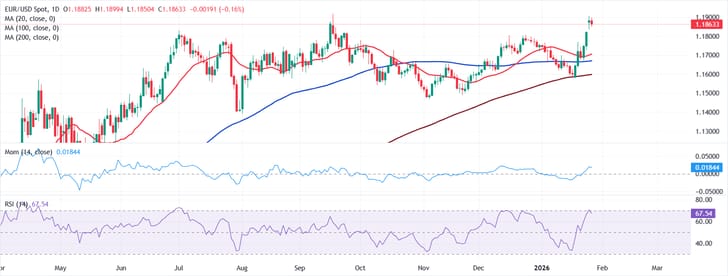

The US Federal Reserve is scheduled to announce its interest rate decision on Wednesday. It is widely anticipated that the central bank will maintain the current policy rate within the 3.5%-3.75% range. Because this outcome is almost entirely priced into the markets, the primary driver for the US Dollar’s (USD) performance will likely be comments made by Fed Chair Jerome Powell during his post-meeting press conference.
Market Consensus and Forecasts According to the CME FedWatch Tool, investors indicate roughly a 98% probability of a policy hold in January, with only a 15% chance of a 25-basis-point rate cut priced in for March. A recent Reuters poll corroborates this view, with all 100 economists surveyed expecting no change to the federal funds rate in January. Furthermore, 58% of respondents now foresee no rate changes throughout the first quarter, marking a shift from December’s poll when at least one cut by March was anticipated.
Analysts at TD Securities agree with the projection of a hold at the 3.50%-3.75% range, arguing that the phase of “risk-management cuts” has concluded and monetary policy is nearing a neutral stance.
“While Powell is likely to sound noncommittal around near term rate cuts, we expect him to remind market participants that the median Fed official still looks for easing this year,” TD analysts note. They anticipate a relatively neutral market reaction to the FOMC meeting. While their long-term view is for rates to decrease later in the year due to improved supply dynamics and strong demand, they acknowledge the near-term risk is that the Fed remains on hold for longer.
Timing and Potential Market Impact on EUR/USD The Fed will announce its rate decision and publish its monetary policy statement at 19:00 GMT, followed by Chair Powell’s press conference at 19:30 GMT.
While the rate decision itself is unlikely to trigger significant market volatility, Powell’s tone could heavily influence USD valuation and drive EUR/USD price action.
If Powell adopts an optimistic tone regarding the inflation outlook while emphasizing the need to support a weakening labor market, investors may interpret this as a dovish signal. In this scenario, the USD could face renewed selling pressure, allowing EUR/USD to gather bullish momentum. Conversely, if Powell indicates the central bank is less concerned about the labor market than it was in late 2025 and highlights persisting upside risks to inflation, the pair could decline. This would reinforce expectations of another hold in March, suggesting room for USD gains based on current market positioning.
Political Context and Fed Leadership Market participants are also closely monitoring headlines regarding the nomination of the next Fed Chair. President Donald Trump could potentially criticize Powell or announce his nominee around the time of the Fed event, increasing volatility and clouding the market reaction.
US Treasury Secretary Scott Bessent recently indicated a decision could come by month’s end, while President Trump mentioned to CNBC a preference for keeping economic adviser Kevin Hassett in his current role.
The final candidates appear to be BlackRock’s Rick Rieder, Fed Governor Christopher Waller, and former Governor Kevin Warsh. Although Powell’s term as Chair ends in May, his term as a governor runs through 2028. He is likely to be asked during the press conference if he intends to complete his full term. If Powell hints at an early departure, and Trump nominates either Waller or Warsh, markets could lean toward a more dovish policy outlook, hurting the USD and boosting EUR/USD.
On the other hand, Rick Rieder is viewed as someone less influenced by politics who would base decisions on economic assessments. While his nomination wouldn’t guarantee a dovish stance, as a “market person,” his appointment might alleviate concerns over the Fed losing its independence.
In a recent post on X regarding inflation data, Rieder stated, “we think the Fed is likely to become increasingly concerned about genuine labor market weakness and will respond with modest reductions in the policy interest rate.” He added, “However, given the noisiness of recent data… the Fed will probably choose to wait a meeting, or so, to begin cutting rates again. 2026 is likely to bring much greater dispersion across monetary policy paths, economic growth trends, and credit markets.”
EUR/USD Technical Outlook Eren Sengezer, European Session Lead Analyst at FXStreet, provides a short-term technical perspective:
“The daily chart shows the Relative Strength Index (RSI) hovering near overbought conditions. EUR/USD holds firm above its 20-day and 100-day Simple Moving Averages (SMA), highlighting a bullish tilt in the short-term technical outlook. On the upside, 1.1918 (the September high) aligns as immediate resistance ahead of the 1.2000 psychological level. On the flip side, 1.1821 (Friday’s close) is seen as the first support level, before the static level at 1.1760, followed by the 20-day SMA at 1.1710. A daily close below the latter could open the door for a steeper slide toward the 1.1600 mark.”