
During Monday’s European trading session, the Pound Sterling (GBP) gained 0.15% against the US Dollar (USD), trading near the 1.3400 level. The GBP/USD pair’s rise is attributed to broad weakness in the Greenback, which is under pressure due to escalating trade disputes between the United States and the European Union over Washington’s ambition to purchase Greenland.
At the time of reporting, the US Dollar Index (DXY), which measures the USD against major peers, is down 0.2% at roughly 99.15. The tension stems from weekend posts on Truth Social by US President Donald Trump, announcing impending 10% tariffs on various EU nations. Citing national security concerns, Trump declared these tariffs effective from February 1, stating they will remain until the US completes a “total purchase” of Greenland.
EU members swiftly condemned the threats, calling them “undesirable” and promising equivalent countermeasures. French President Emmanuel Macron labeled the intimidation “unacceptable.” ANZ analysts note the US Dollar is suffering as markets price in a higher political risk premium.
While the Pound is up against the Dollar, it is trading lower against other major currencies because President Trump also threatened 10% tariffs on the UK regarding the Greenland dispute. UK Prime Minister Keir Starmer responded by stating tariffs are inappropriate against allies, emphasizing a preference for partnership and open dialogue.
Looking ahead, GBP volatility is expected to continue during a busy week for UK economic data. Tuesday features employment figures for the three months ending in November, crucial for gauging the Bank of England’s policy outlook. Markets expect the unemployment rate to dip to 5%, with average earnings growth slowing to 4.6%. Later in the week, the UK will release December CPI and Retail Sales figures, along with preliminary January PMI data.
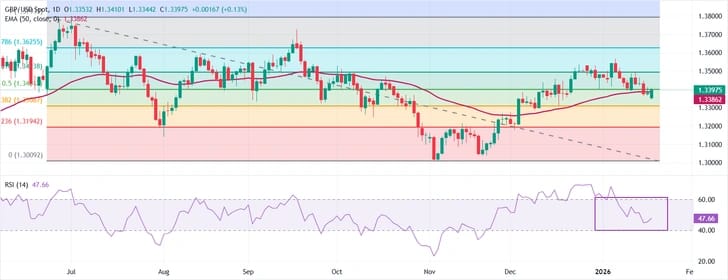
In the US, markets generally expect the Federal Reserve to keep interest rates unchanged at its January meeting. However, Fed Vice Chair Michelle Bowman recently suggested the central bank should be prepared for further cuts due to a fragile labor market. Currently, from a technical perspective, the GBP/USD pair is facing resistance around its 50-day Exponential Moving Average (EMA).
Here are three ways to rephrase the technical analysis text in English, ranging from a standard technical tone to a more narrative style.
Option 1: Standard Technical Analysis Tone (Clean and direct)
At the time of writing, GBP/USD is trading fractionally higher around 1.3397. The short-term bias remains supported as price holds just above the rising 50-day Exponential Moving Average (EMA) located at 1.3386. Momentum has tempered following recent pullbacks, indicated by the 14-day Relative Strength Index (RSI) sitting in neutral territory at 48.
Drawing Fibonacci retracements from the 1.3793 high down to the 1.3009 low, immediate upside is currently restricted by the 50% level at 1.3401. A decisive breakout above this level could propel price towards the 61.8% retracement at 1.3494. Conversely, a closing break below the 38.2% retracement support at 1.3309 would likely extend the decline toward the December low of 1.3180