


The Pound Sterling slid sharply against its major peers on Tuesday after UK labour market figures for the three months to September showed further weakening. The Office for National Statistics (ONS) reported a net loss of 22,000 jobs, reversing the 91,000‐job gain recorded in the three months to August and marking the first overall workforce decline since March 2024. At the same time, the ILO unemployment rate climbed to 5.0%—above forecasts of 4.9% and up from 4.8%—its highest level since March 2021.
These softer employment metrics have intensified market bets that the Bank of England will cut interest rates at its December policy meeting. Dovish expectations were already rising this week after the BoE removed the word “careful” from its guidance on gradual monetary easing in last Thursday’s Monetary Policy Statement.
Wage growth also showed signs of cooling. Average hourly earnings excluding bonuses rose 4.6% year-on-year—matching forecasts but down from 4.7% in the previous quarter—while total earnings including bonuses increased 4.8%, below the 4.9% consensus and last period’s 5.0% pace.
Sterling’s Four-Day Rally Ends as GBP/USD Slides toward 1.3120
Sterling relinquished its four-day winning streak on Tuesday’s European session, slipping toward the 1.3120 area against the U.S. dollar after UK employment figures fell short of expectations.
The dollar itself remained broadly steady as the U.S. Senate approved a government funding bill that now moves to the Republican-controlled House. House Speaker Mike Johnson told Reuters the measure is expected to pass by Wednesday. At the same time, the U.S. Dollar Index (DXY), which tracks the greenback against six major currencies, traded flat near 99.60.
Investors are also eyeing the Federal Reserve’s next move. The CME FedWatch Tool shows a 62.4% probability of a 25-basis-point rate cut to 3.50%–3.75% at December’s meeting. With federal data releases resuming after the government shutdown, markets will soon receive fresh economic signals to guide Fed-rate expectations.
Looking ahead, the key trigger for GBP/USD will be Thursday’s UK GDP updates, including the September monthly reading and the preliminary Q3 figure. Economists forecast the economy expanded 0.2% in the third quarter—down from 0.3% in Q2—which could add further pressure on the pound.
Technical Analysis: Sterling Poised for Further Decline Under 1.3000
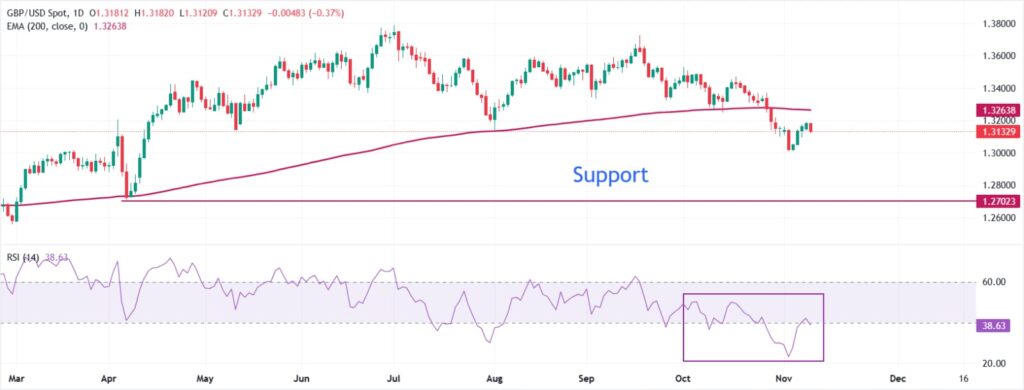
On Tuesday, the Pound Sterling slipped to roughly 1.3130 against the US Dollar, keeping its bearish bias intact as it remains below the 200-day EMA near 1.3264. The 14-day RSI is struggling to climb above 40, and a renewed drop would likely fuel further downside momentum. Support lies at the April low around 1.2700, while the October 28 high near 1.3370 serves as the primary resistance.