

The Japanese Yen (JPY) is holding its ground against the US Dollar during Friday’s Asian session. However, its upward potential is capped by concerns over Japan’s precarious fiscal health. Remarks from Japanese Finance Minister Satsuki Katayama have intensified speculation that authorities might intervene to prevent further JPY depreciation. Additionally, a generally softer trend in equity markets is providing support for the safe-haven JPY.
In a related development, Japan’s cabinet has approved a ¥21.3 trillion economic stimulus package, exacerbating worries about the increasing supply of government debt. Furthermore, the growing consensus that the Bank of Japan (BoJ) will further postpone raising interest rates is also limiting the Yen’s gains. Meanwhile, the US Dollar (USD) is maintaining its recent strength, trading at its highest level since late May due to less dovish Federal Reserve (Fed) expectations, which in turn supports the USD/JPY pair.
Japanese Yen Sustains Gains as Intervention Fears and Risk Aversion Counter Fiscal Worries
Japanese Finance Minister Satsuki Katayama issued her strongest warning yet on Friday, stating that “we will take appropriate action as needed against excess volatility and disorderly market moves, including those in the long term.” Katayama’s comments hinted at the possibility of currency intervention, providing a modest boost to the Japanese Yen during the Asian session.
Earlier today, Japan’s Statistics Bureau reported that the National Consumer Price Index (CPI) and its core measure (excluding fresh food) both rose by 3.0% year-on-year in October. More detailed data revealed that the core CPI (excluding fresh food and energy), a key indicator for the Bank of Japan, came in at 3.1% year-on-year, up from a 3.0% increase in September.
These figures suggest that Japanese inflation remains stubbornly above the central bank’s 2% target, keeping alive hopes for a near-term interest rate hike. Bank of Japan Governor Kazuo Ueda also noted that JPY weakness is increasingly contributing to import costs and consumer inflation, adding that currency fluctuations now have a greater impact than in the past.
A Reuters poll conducted on Thursday indicated that a narrow majority of economists expect the BoJ to raise rates to 0.75% in December, with all forecasters predicting at least that level by the end of Q1 2026. However, uncertainty surrounding a BoJ rate hike persists, largely due to Japanese Prime Minister Sanae Takaichi’s expansionary fiscal policies and her preference for low interest rates.
Japan’s cabinet officially approved a ¥21.3 trillion economic stimulus plan, marking the first significant policy initiative under Prime Minister Sanae Takaichi. The package includes ¥17.7 trillion in general account outlays, surpassing last year’s ¥13.9 trillion and representing the largest stimulus since the COVID-19 pandemic. It will also feature tax cuts totaling ¥2.7 trillion.
In contrast, the US Bureau of Labor Statistics released its delayed Nonfarm Payrolls report on Thursday, showing that the economy added 119,000 new jobs in September. This figure exceeded market expectations of 50,000 and followed an August decrease of 4,000 (revised from a +22,000 increase). The Unemployment Rate slightly rose to 4.4% from 4.3%.
Nevertheless, this data alleviated market concerns about a softening US labor market and further diminished bets for another Federal Reserve interest rate cut in December. The less dovish Fed outlook is helping the US Dollar maintain its strong weekly gains, reaching its highest level since late May, and should help limit losses for the USD/JPY pair.
The USD/JPY technical setup suggests that dip-buyers may emerge at lower levels.
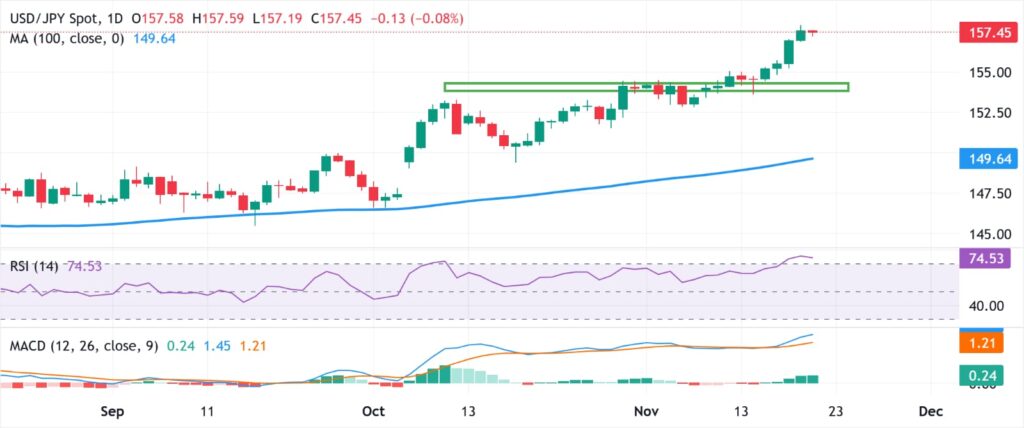
The daily Relative Strength Index (RSI) is currently indicating slightly overbought conditions, which is deterring traders from making new bullish bets on the USD/JPY pair. Given this, it would be wise to anticipate some near-term consolidation or a minor pullback before entering positions for further upward movement.
Should a corrective slide occur, the USD/JPY pair is likely to find solid support just under the 157.00 level. Below this, the 156.65-156.60 zone would be the next significant support area. A break below this could see the pair decline towards the 156.00 mark. The 156.00 level is expected to be a crucial turning point; if breached, it could signal the potential for more substantial losses.
Conversely, the 158.00 level could serve as an immediate obstacle. Surpassing this, the USD/JPY pair might advance towards the next relevant resistance in the mid-158.00s. A continued upward momentum could then push spot prices to test the January swing high, which is located around the 159.00 area.