
The EUR/USD pair is holding steady on the daily chart, trading at 1.1630, just shy of its three-week high of 1.1655 reached on Thursday. The pair is poised to end the week nearly 0.6% higher. While Eurozone GDP confirmed initial estimates and the trade balance improved, negative market sentiment largely constrained the Euro (EUR) throughout the European session.
Specifically, Eurozone GDP showed a 0.2% growth rate for the third quarter (July-September), with the year-on-year figure revised up to 1.4% from 1.3%. Additionally, the September trade surplus expanded significantly to EUR 19.4 billion, a substantial increase from August’s revised 1.9 billion.
The US Dollar, conversely, has been on the defensive for most of the week, despite recent hawkish remarks from Federal Reserve (Fed) officials. On Thursday, St. Louis Fed President Alberto Mussalem and Cleveland Fed President Beth Hammack expressed greater concern over inflation risks than labor market strength. Minneapolis Fed President Neel Kashkari offered a more balanced perspective.
Daily Market Insights: Euro Bolstered by US Dollar Weakness
The Euro’s gains this week have been primarily driven by a weaker US Dollar, rather than robust Eurozone economic data. Investors are hesitant to establish significant long positions in the US Dollar due to an ongoing economic data blackout, and they appear largely unmoved by the hawkish comments from Fed officials. The upcoming release of delayed US economic figures next week is expected to provide a clearer picture of the US economy and set the Dollar’s future direction.
On Thursday, Fed’s Hammack indicated that current monetary policy is only “barely restrictive,” suggesting that interest rates need to be at levels that actively reduce inflation, thus implying opposition to a December rate cut. St. Louis Fed President Mussalem echoed this sentiment, highlighting inflation as the Fed’s primary concern and stating that the central bank has “limited room to ease without becoming overly accommodative.” Meanwhile, Kashkari, in a Bloomberg interview, noted the US economy’s resilience and urged caution regarding further monetary easing. He also stated he is undecided on a December rate cut but lacks a strong inclination towards one.
In Europe, an ECB council member and the Governor of the Bank of Latvia affirmed that the impact of US tariffs has been less severe than initially projected, and that interest rates are likely to remain unchanged unless there’s a significant shift in the economic context.
echnical Analysis: Support at the reverse trendline, approximately 1.1610, is currently being tested
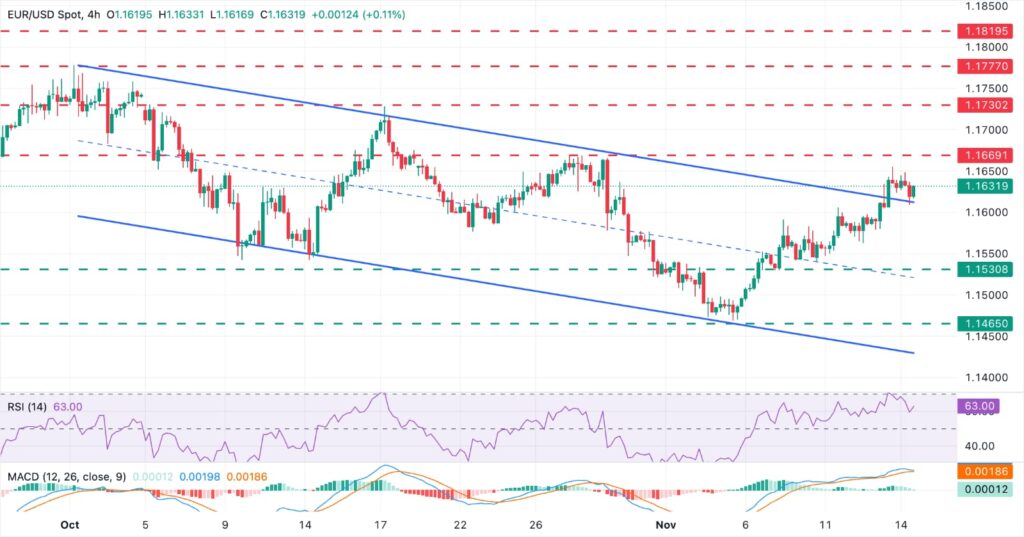
EUR/USD 4-Hour Chart Analysis:
The EUR/USD pair has recently broken above the descending channel that originated from its early October highs and is now consolidating these gains on Friday. While technical indicators generally show positive momentum, the 4-hour Relative Strength Index (RSI) is approaching overbought territory after an eight-day rally. Furthermore, the Moving Average Convergence Divergence (MACD) on the same timeframe appears poised to cross below its signal line. These combined signals suggest that a period of consolidation may be imminent.
For bullish sentiment to be confirmed, the pair needs to hold above the previous channel top, which is currently around 1.1610. If this level holds, traders will be targeting the October 28 and 29 highs, situated near 1.1670. Beyond that, the next upward objective is the October 17 high, close to 1.1730.
Conversely, a correction that pushes the price back below the aforementioned trendline at 1.1610 would likely send the pair seeking support at the November 12 low, near 1.1575. Should that level fail, the focus would shift to the 1.1530-1.1540 zone, which encompasses the lows from November 7 and 10.