

The Australian dollar extended its two-week rally against a broadly weaker U.S. dollar on Wednesday’s Asian trading session, climbing to its highest level since late October. Softer odds of future policy easing by the Reserve Bank of Australia more than offset disappointing Q3 GDP figures and remain a key driver underlining the Aussie’s strength. Meanwhile, a generally upbeat tone in equity markets has lent additional support to the risk-sensitive AUD, which appears unfazed by China’s underwhelming Services PMI. At the same time, the USD hovers near two-week lows amid growing bets on a Federal Reserve rate cut next week, further bolstering the AUD/USD pair and favoring bullish positions.
Australian dollar buying picked up steam even after the Australian Bureau of Statistics reported a 0.4% GDP rise in Q3—down from 0.6% in Q2—and a 2.1% annual growth rate, both below market expectations. Intraday losses around the currency were limited, however, as Reserve Bank Governor Michele Bullock signaled before a parliamentary committee that the RBA is watching recent inflation data closely to determine whether price pressures are enduring. Should inflation prove persistent, Bullock noted, it would have clear implications for future monetary policy, tamping down hopes for imminent rate cuts and lending fresh support to the AUD.
Inflation data released this week showed Australia’s headline Consumer Price Index accelerated to 3.8% year-on-year in October (from 3.5%), while the RBA’s Trimmed Mean CPI climbed to 3.3% (up from 3.2%). Both readings sit above the RBA’s 2–3% target band, raising questions about how much room the central bank has to further ease policy.
China’s Services PMI dipped to 52.1 in November from 52.6 in October—just above forecasts of 52.0—but the modest slowdown has done little to dampen the bullish sentiment surrounding the AUD as a proxy for Chinese economic activity.
On the other side of the ledger, the U.S. dollar remains near its weakest levels since mid-November, weighed down by dovish Fed expectations. The CME Group’s FedWatch Tool currently assigns nearly a 90% probability to a 25 basis-point cut at the Fed’s December 10 meeting, while speculation about a dovish successor to Chair Jerome Powell continues to undermine the greenback.
Prospects for lower U.S. rates, combined with hopes for a peace deal in the Russia-Ukraine conflict, have fostered a positive environment for equities—further pressuring the safe-haven dollar and benefiting the risk-on Aussie. Traders are now focused on upcoming U.S. data releases, including the ADP private-sector employment report and the ISM Services PMI, in search of fresh catalysts.
However, all eyes remain on Friday’s Personal Consumption Expenditures Price Index, the Fed’s preferred inflation gauge, which will be closely dissected for clues about the central bank’s rate-cut path. The outcome will play a pivotal role in shaping the next directional move for AUD/USD, though the overall fundamental backdrop continues to favor bullish traders.
From a technical standpoint, a decisive break above the 0.6600 level could pave the way for an acceleration of the Aussie’s recent upside momentum.
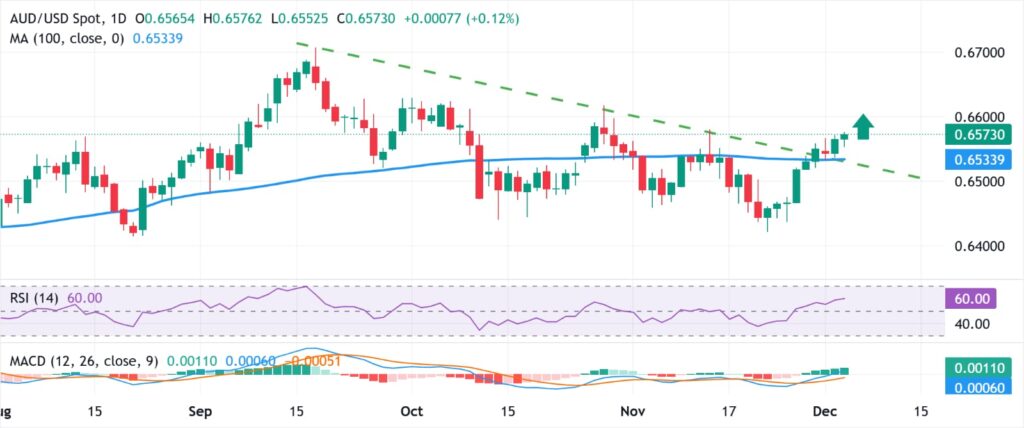
The recent breakout above the downtrend line drawn from September’s swing high, combined with a sustained move over the 100-day simple moving average, has clearly shifted the technical bias in favor of AUD/USD bulls. At the same time, daily chart oscillators are picking up momentum and remain comfortably below overbought levels, reinforcing a near-term bullish outlook. In this scenario, any pullback toward the 0.6530–0.6535 area—where the trend line and moving average converge—should be viewed as a buying opportunity.
Immediate support sits at the 0.6500 psychological level. A decisive break beneath that mark could expose the pair to further weakness, potentially pushing prices below the 200-day SMA near 0.6465 and toward the November low around 0.6420. If sellers manage to force a drop under 0.6400, it would likely trigger fresh bearish momentum and open the door to deeper losses.
That said, as long as the two-week uptrend remains intact, AUD/USD looks set to target 0.6600 next. Clearing that hurdle could fuel further gains toward the 0.6660–0.6665 resistance zone, with an eventual test of the year-to-date high just above 0.6700—last seen in September—coming into view.