
The British Pound (GBP) is attracting significant buying interest against major currencies following unexpectedly strong economic data from the United Kingdom. The flash S&P Global Purchasing Managers’ Index (PMI) for January exceeded projections, and December Retail Sales returned to growth.
The PMI report indicated a robust expansion in overall business output, driven by sharp increases in activity across both manufacturing and service sectors. The Composite PMI surged to 53.9 in January, up from 51.4 in December and surpassing the estimated 51.7. Specifically, the Services PMI reached 54.3, beating both the 51.7 forecast and the previous 51.4 reading. The Manufacturing PMI also saw a significant rise to 51.6 from the prior 50.6 level.
Simultaneously, Retail Sales rebounded in December after contracting for the previous two months. The Office for National Statistics (ONS) reported that this key consumer spending measure rose by 0.4% month-on-month, defying expectations of a steady 0.1% decline. On an annualized basis, consumer spending surged by 2.5%, significantly outpacing the market consensus of moderate 1% growth. The November figure was also revised upward to 1.8% from 0.6%.
This strong UK Retail Sales data is expected to reduce market speculation regarding near-term interest rate cuts by the Bank of England (BoE).
Looking ahead, next week’s UK economic calendar is light. Therefore, market sentiment and expectations regarding the BoE’s February monetary policy decision are likely to be the primary drivers for Sterling.
Daily Digest Market Movers: Investors Wary of Trump’s Trade Stance
During Friday’s European trading session, the Pound Sterling is trading firmly near a two-week high of 1.3500 against a weakened US Dollar (USD). The GBP/USD pair remains strong as the Greenback underperforms broadly, with investors growing cautious about President Trump’s long-term trade relationships.
At the time of writing, the US Dollar Index (DXY), tracking the currency against six major peers, is trading slightly higher near 98.45, though it remains close to the two-week low of 98.28 reached on Thursday.
Since President Trump imposed tariffs to address the US trade deficit, relations with major economies like India and China have been unstable. Additionally, US-Russia understandings have been repeatedly tested amid the ongoing war in Ukraine.
Meanwhile, trade and geopolitical tensions between the US and the European Union (EU) have eased somewhat. Trump retreated from the idea of forcefully purchasing Greenland and rolled back 10% tariffs on several EU members following a meeting with NATO Secretary General Mark Rutte. During the meeting, they reached a framework for a “future deal with respect to Greenland, and in fact, the entire Arctic Region.”
However, market experts view this framework as a temporary solution that does not resolve concerns over Washington’s unpredictability, raising questions about global stability and potentially impacting the US Dollar’s reserve currency status.
Domestically, investors are awaiting the Federal Reserve’s monetary policy announcement on Wednesday. According to the CME FedWatch tool, the Fed is widely expected to hold interest rates steady in the 3.50%-3.75% range.
Technical Analysis: GBP/USD trades firmly near 1.3500.
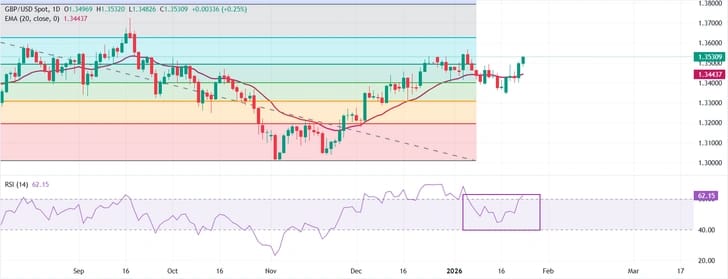
At the time of writing, the GBP/USD pair has continued its upward trajectory, trading in the vicinity of 1.3530. The near-term bullish bias remains intact as prices maintain a position above the ascending 20-day Exponential Moving Average (EMA) located at 1.3444.
Supporting this positive momentum is the 14-day Relative Strength Index (RSI), currently reading at a bullish 62.15, indicating strengthening buying pressure without yet reaching overstretched levels.
Based on the Fibonacci retracement drawn from the 1.3793 high to the 1.3009 low, the 61.8% level at 1.3494 now serves as immediate support. A sustained hold above this threshold would pave the way for a potential move toward the 78.6% retracement at 1.3625. Conversely, a failure to maintain gains above this level would likely cap the current rebound and lead to a period of consolidation.