Quick Snapshot: What’s Live on PinkSale Right Now
Key Numbers at a Glance (Supply, Caps, Limits)
Here are the main pool details shown for SolLab on PinkSale (Solana):
| Item | Value |
|---|---|
| Sale type | Public |
| Soft cap | 1 SOL |
| Max buy | 20 SOL |
| Tokens for presale | 660,000,000 LAB |
| Tokens for liquidity | 336,600,000 LAB |
| Liquidity percent | 51% |
| Liquidity lockup | 183 days after pool ends |
| Listing DEX | Raydium AMM V4 |
All of the above comes directly from the PinkSale Solana pool page. (PinkSale)
A quick note: PinkSale also shows token decimals (9) and the token mint address, with a warning not to send SOL to the token address. (PinkSale)
Dates & Timezone Conversion (UTC → WIB)
PinkSale shows:
- Start: 2026-01-12 15:00 (UTC)
- End: 2026-01-14 17:00 (UTC) (PinkSale)
Converted to WIB (Asia/Jakarta, UTC+7):
- Start: 2026-01-12 22:00 WIB
- End: 2026-01-15 00:00 WIB (midnight)
So if you’re in Indonesia, the launch begins late on Monday night, Jan 12, 2026.
Where It Lists Afterward (Raydium AMM V4)
PinkSale explicitly lists the router as Raydium AMM V4 for SolLab’s listing. (PinkSale)
This matters because “auto listing” generally implies the liquidity gets created on the chosen DEX router after finalization (instead of the team doing it manually). (PinkSale)
What SolLab Is Trying to Build on Solana
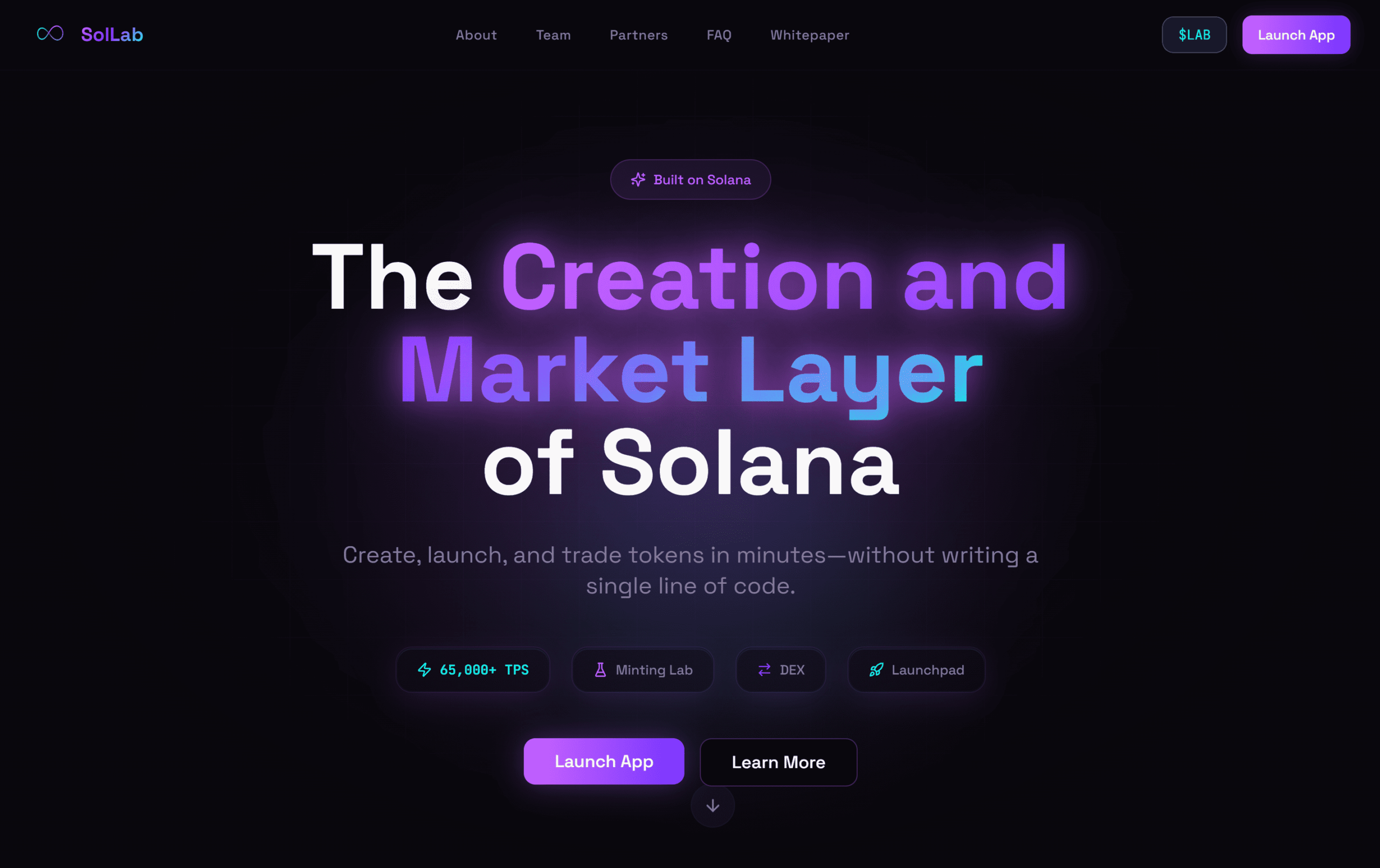
SolLab’s positioning (as shown on PinkSale) is simple and attractive: an all-in-one platform that helps people create, launch, and trade tokens through a unified no-code experience—“Minting Lab • Launchpad • DEX”—with $LAB described as “utility & governance.” (PinkSale)
That pitch is popular in crypto for a reason: Solana moves fast, fees are low, and people want tools that reduce technical friction. But the real question for buyers is: Is this actually a useful platform, or just a nice idea with token hype? Let’s break the concept down in plain English.
No-Code Token Creation (SPL Standard Token Basics)
On Solana, most “normal” tokens are SPL tokens. SPL is the token standard that defines how balances, transfers, and token accounts work. Solana’s own documentation explains SPL token basics and how they’re commonly interacted with. (Solana)
So a “no-code token minting lab” usually means:
- You click through a UI
- The app generates the necessary instructions/transactions
- Your wallet signs them
- The token mint gets created with chosen parameters (name/symbol typically via metadata tools, decimals, supply model, etc.)
This can be genuinely helpful for creators and communities who don’t want to touch command lines. But it also creates a flood of low-effort tokens—so the tool’s safety rails become the real product: warnings, best practices, and default settings that reduce common mistakes.
Launch Tools + Liquidity Lock: Why It Matters
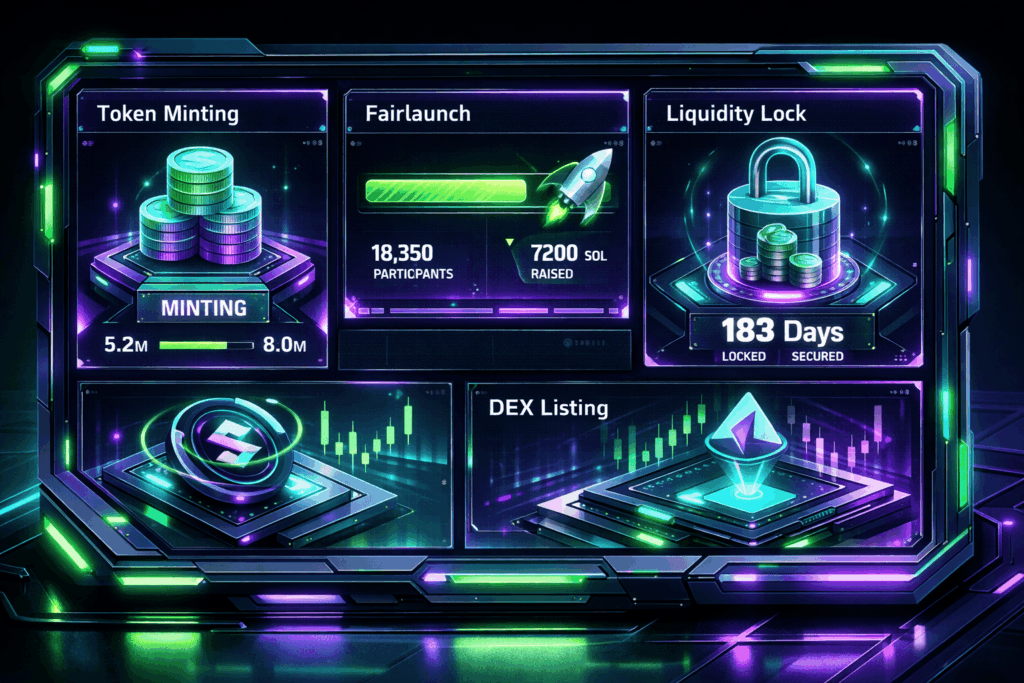
SolLab’s PinkSale description emphasizes launch tools and liquidity lock. (PinkSale)
On PinkSale’s own Solana fairlaunch documentation, creators configure liquidity percentage and lockup days, and auto listing can handle liquidity creation after finalization. (PinkSale)
From a buyer’s point of view, liquidity lock is mainly about reducing one ugly risk: liquidity being pulled immediately after listing. Locking liquidity doesn’t make a token “safe,” but it can reduce one common exit scam pattern.
For SolLab specifically, PinkSale displays:
- 51% liquidity
- 183 days lock after the pool ends (PinkSale)
That’s a meaningful window—if it’s enforced the way it appears.
Trading Layer Ambition: From Launchpad to DEX
SolLab is also described as offering “pro on-chain trading on Solana.” (PinkSale)
This is the hardest part to execute well.
Building a solid “trading layer” means competing with:
- existing DEX UIs,
- aggregators,
- and analytics tools.
A serious product here needs reliability, routing quality, and clear transparency. If SolLab ships a clean experience, it could earn real users. If not, the token may rely mostly on marketing.
Audit & Safety Signals: What BlockSAFU Shows
BlockSAFU lists SolLab as:
- Project name: SolLab
- Symbol: LAB
- Platform: Solana
- Token type: SPL Standard Token
- Audit release: #232
- Audit timeline showing Release at 2026-01-10
It also displays categories of checks performed like:
- Manual review
- Static analysis
- Freeze authority check
- Mint authority check
- Mutable check
- Dynamic testing
What Checks Are Mentioned (Mint/Freeze/Immutability)
These checks matter because they map to common “control levers” in Solana tokens:
- Mint authority: can more supply be minted later?
- Freeze authority: can accounts be frozen?
- Immutability / mutability: can token metadata be changed?
If you’re new, here’s the simple idea: the fewer surprise control levers that remain active, the fewer ways the token can be changed on holders after launch.
What the Audit Page Doesn’t Prove (And How to Verify)
Important: the BlockSAFU page (as publicly readable) shows the types of checks and a timeline, but it does not clearly show the pass/fail results for each item in the text view we can access.
So treat it as a signal, not a guarantee.
Simple Investor Checklist Before Buying
Here’s what I’d personally verify before participating:
- Confirm the exact token mint address matches across PinkSale and the audit listing. (PinkSale)
- Check whether mint authority and freeze authority are disabled (or understand who controls them).
- Confirm liquidity lock details after finalization (don’t assume; verify on-chain). (PinkSale)
- Watch for impersonators: PinkSale itself warns users to ensure the domain is correct. (PinkSale)
- Avoid rushing in the last minutes if you might use emergency withdraw (more below). (PinkSale)
Fairlaunch Mechanics: How Pricing Usually Works
Fairlaunch vs Presale (Plain-English Difference)
PinkSale’s documentation explains a key idea: a fairlaunch typically doesn’t have a fixed token price like a classic presale rate. Instead, the final price is derived from total funds raised divided by the total selling amount. (PinkSale)
That means:
- If lots of people pile in, the implied price changes.
- Your entry isn’t at a guaranteed fixed rate the way some presales work.
Auto Listing Explained
For Solana fairlaunch creation, PinkSale describes Auto Listing as PinkSale automatically creating liquidity on the chosen DEX after the pool is finalized, using the configured liquidity percentage. (PinkSale)
For SolLab, PinkSale shows:
- Router: Raydium AMM V4
- Liquidity percent: 51%
- Lockup: 183 days (PinkSale)
That’s coherent with how fairlaunch pools are typically configured.
Participation Walkthrough (Beginner-Friendly)
Wallet, Fees, and Avoiding Fake Sites
PinkSale’s “How to Buy” guide is straightforward: connect your wallet on the correct network, view the pool, enter amount, and confirm in your wallet. (PinkSale)
For Solana specifically, PinkSale shows an additional reminder on the SolLab pool page:
- You need SOL for network fees (it mentions at least 0.01 SOL for fees). (PinkSale)
- “Make sure the website is pinksale.finance.” (PinkSale)
That warning exists because fake clones are common.
Emergency Withdraw: The 10% Penalty Reality
PinkSale documents that Emergency Withdraw exists (for presales, fairlaunches, subscriptions), but it comes with a 10% penalty, returning 90% of your contribution. (PinkSale)
It also states:
- You can use it until the last 15 minutes before the pool ends (then it becomes unavailable). (PinkSale)
So, if you’re the type who might change your mind, don’t wait until the final minutes.
Pros, Cons, and Who This Might Fit
Pros
- Clear pool parameters (max buy, liquidity %, lock time, router) are displayed in one place. (PinkSale)
- Liquidity lock window (183 days) is longer than many quick flips. (PinkSale)
- Audit listing exists with a dated release timeline (Jan 10, 2026).
- The product vision (no-code minting + launch + trading) matches real demand on Solana. (PinkSale)
Cons / Risks
- A fairlaunch has limited historical proof until the product ships and users stick around.
- The BlockSAFU page shows check categories, but readers should still verify outcomes on-chain (don’t assume “audited” means “safe”).
- External site availability can be inconsistent (even BlockSAFU’s site scan notes Cloudflare / status signals).
- Community/KYC signals vary by third-party trackers (some listings may show “not audited” or “not KYC” because data is user-submitted or not updated). (CoinSniper)
Who this might fit
- You like early-stage Solana tooling bets and you size risk small.
- You understand that launchpads are not endorsements and you verify everything.
Who should skip
- You want stable fundamentals, long revenue history, or low volatility.
- You don’t have time to verify mint authority, liquidity lock, and official channels.
Helpful External Resources (Links)
Reference pages used in this review:
https://blocksafu.com/audit-solana/6hVEQ15HUp5sRv1jSXdcGSr7FAQjh3rUQSMkj655sRV7
https://www.pinksale.finance/solana/launchpad/7dpb5eeeqXHf7tRwH1V2ze9k4DozUAyNhneASvk48pfK

Extra learning:
https://docs.pinksale.finance/solana/create-a-fairlaunch
https://solana.com/docs/tokens/basics
FAQ (Real Questions People Ask)
1) When does the SolLab fairlaunch start and end?
PinkSale shows 2026-01-12 15:00 UTC to 2026-01-14 17:00 UTC. (PinkSale)
That’s 22:00 WIB (Jan 12) to 00:00 WIB (Jan 15).
2) What does “Auto Listing” mean here?
PinkSale explains Auto Listing as PinkSale automatically creating liquidity on the chosen DEX after finalization, using the configured liquidity percentage. (PinkSale)
3) Is there a fixed token price in a fairlaunch?
Usually no. PinkSale notes fairlaunch pricing is determined by total funds raised divided by the total selling amount (instead of a fixed presale rate). (PinkSale)
4) What is the max contribution?
The SolLab pool shows max buy = 20 SOL. (PinkSale)
5) What happens if I emergency withdraw?
PinkSale documents a 10% penalty, meaning you get back 90% of what you put in, and it’s disabled in the final 15 minutes. (PinkSale)
6) Does an audit guarantee safety or profits?
No. Even the audit page includes a disclaimer that audits are technical evaluations and not endorsements, and investors must DYOR.
7) Where will it list after the fairlaunch?
PinkSale shows listing on Raydium AMM V4. (PinkSale)
Conclusion: My Review Verdict + Risk Summary
From what’s publicly visible today, SolLab looks like a well-packaged Solana tooling concept with clearly displayed fairlaunch parameters (liquidity %, lock time, max buy, router) and an audit listing timeline that at least signals preparation. (PinkSale)
My “promising yet risky” verdict comes down to this:
- Promising if the team actually delivers a smooth no-code product people use (minting + launch + trading) and continues to reduce user mistakes with real safety rails. (PinkSale)
- Risky because early launches can move faster than verification. The smart approach is to verify on-chain permissions (mint/freeze), confirm liquidity lock behavior after finalization, and never treat “audited” as “guaranteed.”