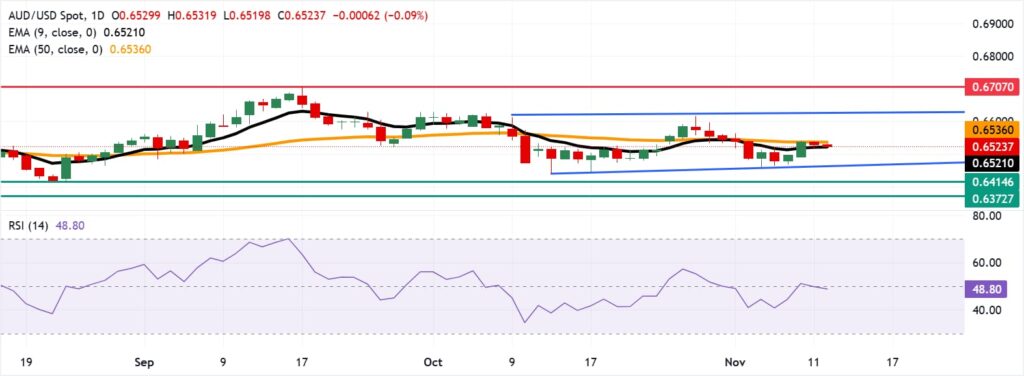

The Australian dollar (AUD) extended its losses for a second straight session on Wednesday, slipping against a firmer U.S. dollar (USD) as optimism grew that the U.S. government shutdown is about to end.
RBA policy comments offered little support to the AUD. Deputy Governor Andrew Hauser reiterated that “monetary policy remains restrictive,” noting the board is still debating whether conditions have eased enough to warrant a change. Meanwhile, Assistant Governor Brad Jones warned at the ASFA Conference in Broadbeach that markets are underestimating geopolitical risks, remain complacent on valuations, and are beginning to see fragmentation in central-bank gold reserves.
On the U.S. side, the dollar index (DXY)—which tracks the USD against six major peers—halted its five-day slide and traded near 99.50. Traders are also eyeing speeches later today from Fed officials Christopher Waller, Raphael Bostic and Stephanie Miran for fresh clues on monetary policy.
The Senate has approved the funding bill to end the partial government shutdown, and the House is set to vote on it Wednesday before sending it to President Trump’s desk. Trump has indicated he will sign the bipartisan agreement, which would reopen government offices, restart federal paychecks and clear the way for the release of stalled economic data.
White House Treasury Secretary Scott Bessent cautioned this week that the shutdown’s damage to the economy is mounting. Recent data—such as October’s government and retail layoffs and the tumble in consumer sentiment to a 3½-year low—have reinforced market bets on Fed rate cuts. The CME FedWatch Tool now shows roughly a 68% chance of a 25 bp cut in December.
China developments also loom over the AUD. Beijing said it will temporarily lift its export ban on certain “dual-use” materials to the U.S. through November 2026, a move that could affect Australia’s trade dynamics with its largest partner. Meanwhile, China’s October CPI rose 0.2% year-on-year (versus –0.3% in September) and 0.2% month-on-month, while the PPI eased by 2.1% year-on-year—both coming in slightly stronger than expected.
Closer to home, the University of Melbourne’s Westpac Consumer Confidence Index jumped 12.8% in November to 103.8, marking its strongest non-pandemic reading in seven years as economic concerns eased.
Technical Outlook for AUD/USD
On Wednesday, AUD/USD traded around 0.6520, hovering just above its nine-day exponential moving average (EMA). A decisive break below the 0.6520 EMA—and the 0.6500 psychological mark—could undermine near-term momentum and target the lower boundary of its rectangle consolidation around 0.6470, with the five-month low of 0.6414 (August 21) coming into view.
Upside resistance begins at the 50-day EMA near 0.6536; a successful push above that level would open the door to the top of the range near 0.6630. Beyond there, the 13-month peak at 0.6707 (September 17) would be the next key objective.