
The Australian Dollar (AUD) is surrendering its daily gains against the US Dollar (USD) this Friday, even as the USD extends its winning streak to a sixth consecutive day. However, looking beyond the USD pair, the AUD has broadly strengthened against other major currencies. This broader AUD strength is a direct response to hotter-than-expected inflation data for October, which saw consumer prices rise for the fourth consecutive month, pushing well above the Reserve Bank of Australia’s (RBA) 2%-3% target band. This development is tempering expectations of RBA easing and reintroducing the risk of another rate hike. Despite this, the RBA is widely expected to maintain the Official Cash Rate (OCR) at 3.6% in December, acknowledging a slight increase in the unemployment rate while noting the job market remains robust. Current futures pricing implies only a 6% chance of a December RBA rate cut.
Further supporting the AUD against the USD, the RBA reported stronger Private Sector Credit growth for October, beating forecasts. Simultaneously, the AUD/USD pair has been buoyed by a struggling US Dollar, which faces headwinds from escalating expectations of a Federal Reserve (Fed) interest rate cut in December. The CME FedWatch Tool now shows an impressive over 87% probability of a 25 basis-point cut next month, a dramatic increase from just 39% a week ago. Traders are also factoring in three additional rate cuts by the end of 2026, especially after reports suggested Kevin Hassett, known for aligning with US President Donald Trump’s preference for lower interest rates, is a leading candidate for the next Fed chair.
US Dollar Defies Dovish Bets: Despite the overwhelming market consensus for Fed rate cuts, the US Dollar Index (DXY) is paradoxically holding firm, trading around 99.60. Recent US economic indicators have delivered a mixed bag:
- Jobless Claims: Initial Jobless Claims surprisingly fell to 216,000 for the week ending November 22, beating expectations.
- Inflation Gauges: The Producer Price Index (PPI) remained stable at 2.7% YoY, while Core PPI eased slightly.
- Consumer Spending & Confidence: US Retail Sales slowed to a modest 0.2% MoM, and the Conference Board reported a sharp decline in Consumer Confidence in November.
- Fed Official’s Stance: Fed Governor Christopher Waller expressed growing concern over the labor market, stating inflation is “not a big problem” given recent employment softness, hinting at support for a near-term rate cut.
Resilient Australian Economy: Recent Australian economic data has been largely positive, providing a strong foundation for the AUD:
- Private Capital Expenditure: Rose significantly by 6.4% QoQ in Q3, vastly exceeding forecasts.
- Monthly CPI: Climbed to 3.8% YoY in October, surpassing market expectations and prior readings.
- PMI Data: Preliminary S&P Global Manufacturing, Services, and Composite PMIs for November all showed expansion, suggesting robust economic activity.
- RBA’s Balanced View: The November RBA Minutes indicated a shift towards a more balanced policy stance, signaling a willingness to maintain the cash rate unchanged for a longer period if incoming data continues to be stronger than anticipated.
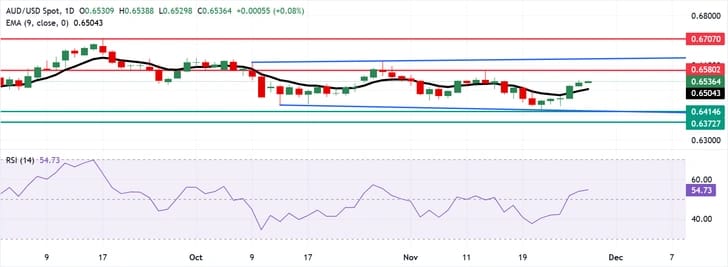
AUD/USD Technical Analysis: Currently trading around 0.6540, the AUD/USD pair is positioned within a well-defined rectangular consolidation zone on the daily chart, which suggests a neutral overall bias. However, the price has moved above the nine-day Exponential Moving Average (EMA), indicating a strengthening short-term bullish momentum.
- Potential Upside: The AUD/USD pair could target the monthly high of 0.6580, followed by the psychological level of 0.6600. A break above this confluence resistance zone would likely enable the pair to explore the rectangle’s upper boundary near 0.6630.
- Key Support Levels: Initial support is expected at the nine-day EMA at 0.6504, aligning with the psychological 0.6500 mark. A decisive breach of this crucial support area would likely prompt the AUD/USD pair to test the rectangle’s lower boundary around 0.6420, a level that aligns with the five-month low of 0.6414 recorded on August 21.