
The Australian Dollar (AUD) is holding firm against the US Dollar (USD) on Thursday, following the People’s Bank of China’s (PBoC) decision to maintain its Loan Prime Rates (LPRs) in November. Both the one-year and five-year LPRs remained unchanged at 3.00% and 3.50% respectively. As China is a significant trading partner for Australia, its monetary policy decisions have implications for the AUD.
Reserve Bank of Australia (RBA) Assistant Governor Sarah Hunter stated on Thursday that “sustained above-trend growth could fuel inflationary pressures.” Hunter emphasized that monthly inflation data can be volatile and that the central bank will not react to single month figures. She further noted that the RBA is diligently assessing labor market conditions to gauge supply capacity and studying how the effects of monetary policy are evolving over time.
The AUD/USD pair rebounded after a more than 0.5% loss in the previous session. This recovery was driven by improved market sentiment, largely fueled by chip giant Nvidia’s impressive earnings report.
The AUD is also finding support from growing expectations of a cautious approach from the Reserve Bank of Australia. Minutes from the RBA’s November meeting indicated that the central bank might keep rates unchanged for an extended period if economic data continues to exceed expectations. Steady Q3 wage growth, last week’s strong jobs figures, and persistently high inflation have all reinforced the view that the easing cycle has likely concluded.
ASX 30-Day Interbank Cash Rate Futures, as of November 18, show the December 2025 contract trading at 96.41. This implies a modest 8% probability of a rate cut to 3.35% from 3.60% at the upcoming RBA Board meeting.
US Dollar Surges Amid Declining Fed Rate Cut Expectations
The US Dollar Index (DXY), which tracks the US Dollar’s value against six major currencies, is stronger, trading around 100.20 at the time of writing. Traders are now awaiting the release of the US September Nonfarm Payrolls (NFP) report later on Thursday for fresh insights into the Federal Reserve’s (Fed) policy outlook.
The Greenback gained over 0.5% in the previous session as markets scaled back expectations for another Federal Reserve rate cut in December, following the latest Federal Open Market Committee (FOMC) Meeting Minutes. The October 28-29 FOMC Minutes indicated that Fed officials are divided and cautious about the future path of interest rates. While most participants suggested further rate cuts might be appropriate over time, several noted they did not necessarily view a reduction in December as suitable.
The CME FedWatch Tool now suggests that financial markets are pricing in a 33% chance of the Fed cutting its benchmark overnight borrowing rate by 25 basis points (bps) at its December meeting, a significant drop from the 63% probability priced in a week ago.
Richmond Fed President Thomas Barkin stated on Tuesday that the labor market appears more balanced, with firms reporting improved worker availability and recent layoffs signaling the need for caution. Barkin observed that inflation doesn’t seem to be rising, but it’s also unclear whether it will return to the Fed’s 2% target. He emphasized that without more decisive data, achieving a broad policy consensus remains challenging.
US President Donald Trump mentioned in a Tuesday Oval Office interview that he “would love” to remove Fed Chair Jerome Powell immediately. Trump added that he already has a preferred candidate in mind, noting that “some surprising names” are under consideration, though a more traditional option might ultimately be chosen.
Federal Reserve Vice Chair Philip Jefferson commented on Monday that risks to the labor market now outweigh upside risks to inflation, stressing that the Fed should proceed “slowly” with any additional rate reductions.
Data released by the US Department of Labor (DOL) on Tuesday showed 232,000 Initial Jobless Claims in the week ending October 18, with Continuing Claims rising slightly to 1.957 million from 1.926 million in the prior week. Weekly data for initial claims for the preceding three weeks were unavailable. Meanwhile, an Automatic Data Processing (ADP) report indicated that employers cut an average of 2,500 jobs per week during the four weeks ending November 1.
National Economic Council Director Kevin Hassett cautioned that some October data might “never materialize” due to agencies being unable to collect information during the shutdown. Initial private-sector reports suggest a cooling labor market and wavering consumer confidence, coupled with persistent inflation concerns.
Australia’s seasonally adjusted Wage Price Index rose 0.8% quarter-on-quarter in Q3, consistent with the previous period and forecasts. Annually, wages increased 3.4%, also matching the prior quarter’s pace and market expectations. The Reserve Bank of Australia published the Minutes of its November monetary policy meeting on Tuesday, which indicated that board members signaled a more balanced policy stance, adding that the cash rate could remain unchanged for longer if incoming data proves stronger than expected.
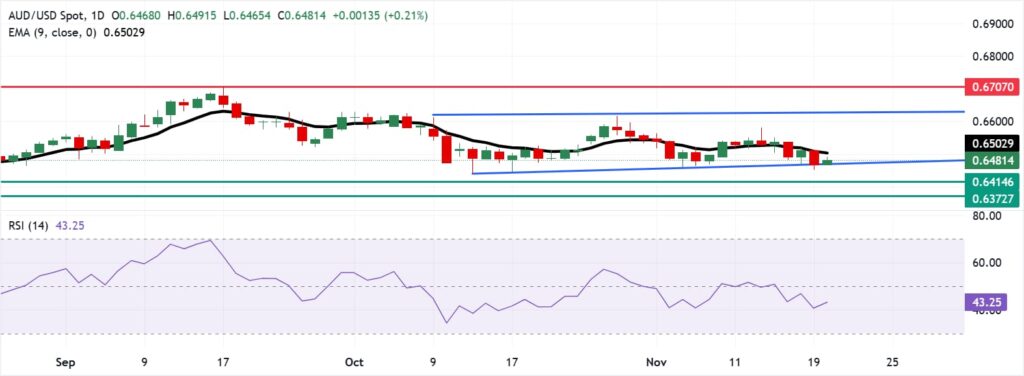
Australian Dollar Nears 0.6500 After Rebounding from Rectangle Boundary
The AUD/USD pair is trading around 0.6480 on Thursday. Daily chart analysis shows the pair moving sideways within a rectangular range, indicating a period of price consolidation. The price remains below the nine-day Exponential Moving Average (EMA), suggesting weaker short-term price momentum.
On the downside, the AUD/USD pair finds immediate support at the rectangle’s lower boundary around 0.6470, followed by the five-month low of 0.6414 recorded on August 21.
The initial resistance lies at the psychological level of 0.6500, followed by the nine-day EMA at 0.6503. A break above this confluence resistance zone would improve short-term price momentum and could lead the pair to reach the rectangle’s upper boundary near 0.6630.
Here’s an image that visualizes the Australian Dollar receiving support, with elements like the RBA’s cautious remarks and China’s steady rates, alongside the dynamic of the US Dollar’s strength.