

The Japanese Yen (JPY) is weakening for the fourth consecutive day against a generally firmer US Dollar (USD), pushing the USD/JPY pair to its lowest level since mid-January during Thursday’s Asian session. Investors are increasingly concerned about Japan’s precarious fiscal situation, exacerbated by Prime Minister Sanae Takaichi’s new economic stimulus package. Furthermore, earlier this week, data revealed that Japan’s economy unexpectedly contracted in Q3 for the first time in six quarters. This contraction could pressure the Bank of Japan (BoJ) to further delay interest rate hikes, continuing to undermine the JPY.
Adding to the JPY’s woes, a prevailing risk-on sentiment is eroding its safe-haven appeal. Conversely, the USD is advancing to its highest level since late May, supported by less dovish Federal Reserve (Fed) expectations, providing additional upward momentum for the USD/JPY pair. Despite recent verbal interventions from Japanese authorities in response to the JPY’s decline, these efforts have provided little relief for JPY bulls, suggesting that the Yen’s path of least resistance remains downwards. Traders are now keenly awaiting the delayed release of the US Nonfarm Payrolls (NFP) report for fresh market impetus.
Japanese Yen’s Underperformance Persists Despite Verbal Intervention
Japan’s Chief Cabinet Secretary Minoru Kihara stated on Thursday that recent foreign exchange (FX) movements are sharp and one-sided, emphasizing that he is monitoring the FX market with a high sense of urgency. Kihara reiterated that the FX market needs to move stably, reflecting fundamentals.
This statement follows a fresh warning from Japan’s Finance Minister Satsuki Katayama on Wednesday, who also expressed the government’s close monitoring of markets with a high sense of urgency. While these comments fuel fears of intervention, they have done little to curb the prevailing selling bias against the Japanese Yen.
Japan’s yield curve has steepened significantly as investors price in a larger-than-anticipated spending package from Prime Minister Sanae Takaichi’s new administration. Goushi Kataoka, a member of a key government panel, indicated earlier this week that Japan should compile a stimulus package of approximately ¥23 trillion. Kataoka further added on Wednesday that the Bank of Japan is unlikely to raise interest rates before March, arguing that policymakers must first confirm that a major fiscal package is boosting domestic demand. This signals the Takaichi administration’s preference for maintaining low interest rates.
Government data released on Monday confirmed that Japan’s economy contracted for the first time in six quarters during the July-September period. This further dampens expectations for an imminent BoJ rate hike and is likely to deter JPY bulls from placing aggressive bets.
The US Dollar is nearing its highest level since May, previously touched earlier this month, driven by less dovish Federal Reserve expectations. Indeed, the probability of another rate cut in December has decreased after the October FOMC meeting minutes revealed that members were divided on the path forward.
Traders are now looking forward to the delayed release of the US Nonfarm Payrolls (NFP) report for further clues regarding the Fed’s rate-cut trajectory. This report is expected to significantly influence the USD and provide impetus to the USD/JPY pair later in the North American session.
Technical Outlook: USD/JPY Bulls May Pause as Daily RSI Shows Overbought Conditions
Here’s an image that illustrates the Japanese Yen’s decline against a stronger US Dollar, capturing the essence of intervention fears and economic data.
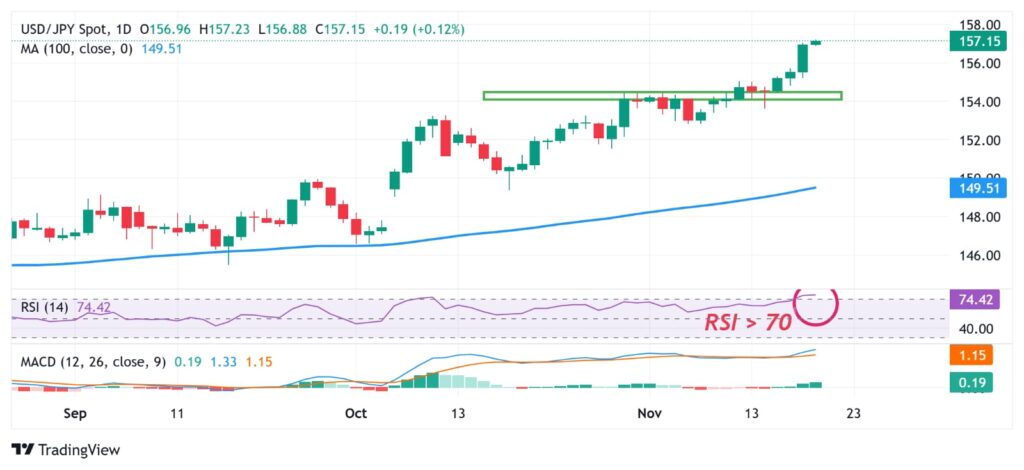
The daily Relative Strength Index (RSI) is currently indicating slightly overbought conditions, which is deterring traders from initiating new bullish positions in the USD/JPY pair. Therefore, it would be wise to anticipate some near-term consolidation or a minor pullback before entering positions for further appreciation.
However, any potential corrective slide is likely to encounter strong support around the 156.65-156.60 region. A break below this level could extend the USD/JPY pair’s decline towards the 156.00 mark. The 156.00 level is expected to be a pivotal point, and sustained weakness below it might trigger technical selling, leading to further losses.
Conversely, the 157.40-157.45 region is expected to act as an immediate resistance. A decisive break above this area could accelerate the USD/JPY pair’s momentum towards reclaiming the 158.00 psychological level. The next significant resistance is located near the mid-158.00s, after which spot prices might target the January swing high, around the 159.00 vicinity.