
The Australian Dollar (AUD) is depreciating against the US Dollar (USD) on Monday, reversing gains from the previous session. The AUD/USD pair is weakening as the US Dollar strengthens due to cautious statements from US Federal Reserve (Fed) officials, which are reducing expectations for a December interest rate cut.
The AUD had previously found support from strong domestic employment data, reinforcing expectations for a conservative stance from the Reserve Bank of Australia (RBA). As of November 14th, the ASX 30-Day Interbank Cash Rate Futures for December 2025 indicated only a 6% probability of an RBA rate cut to 3.35% from 3.60% at the upcoming meeting.
Last week, RBA Deputy Governor Andrew Hauser noted, “Our best estimate is that monetary policy remains restrictive, though the committee continues to debate this.” Hauser emphasized that if policy is no longer mildly restrictive, it would significantly influence future decisions.
In other news, Reuters reported on Sunday that US Treasury Secretary Scott Bessent expressed optimism that a rare earths agreement between the United States and China would be finalized by Thanksgiving. He also voiced confidence in China’s commitment to uphold agreements following the recent meeting between President Trump and President Xi Jinping in Korea.
US Dollar Advances Due to Diminishing Fed Rate Cut Bets
The US Dollar Index (DXY), which tracks the USD against six major currencies, is currently trading around 99.40, extending its advance. Traders are bracing for a backlog of US economic data following the government’s reopening.
The CME FedWatch Tool now suggests a 46% chance of a 25 basis point (bps) Fed rate cut in December, down from 67% a week ago. This shift is partly due to comments like those from Kansas City Fed President Jeffery Schmid, who stated Friday that monetary policy should “lean against demand growth” and that the current “modestly restrictive” policy is appropriate.
National Economic Council Director Kevin Hassett warned that some October data might “never materialize” due to the shutdown’s impact on data collection. Initial private-sector reports suggest a cooling labor market and wavering consumer confidence, with ongoing inflation concerns.
The record 43-day US government shutdown officially ended last Thursday when President Donald Trump signed a funding bill. St. Louis Fed President Alberto Musalem indicated Thursday that rates are closer to neutral than restrictive and the US economy remains resilient, though he stressed caution against overly accommodative policy. Minneapolis Fed President Neel Kashkari noted mixed economic signals and strained labor market segments, with inflation still too high at 3%.
Earlier, Automatic Data Processing (ADP) reported an average weekly job loss of 11,250 in the four weeks to October 25th, indicating a weaker private US labor market and increasing the likelihood of Fed policy easing. Challenger, Gray & Christmas announced that US employers cut 153,074 jobs in October, significantly more than the 55,597 cuts in October 2024.
Regarding China, the National Bureau of Statistics (NBS) reported Friday that Retail Sales grew 2.9% year-over-year (YoY) in October, slightly below September’s 3.0% but above the 2.7% forecast. Industrial Production increased 4.9% YoY, missing the 5.5% forecast and below the previous 6.5%. Fixed Asset Investment showed a year-to-date (YTD) YoY contraction of 1.7% in October, missing the expected -0.8% and worse than September’s -0.5%.
At its Friday press conference, China’s NBS outlined its economic outlook, committing to fostering new productive forces. It noted that improved supply-demand dynamics and rising prices for services and industrial goods pushed October CPI back into positive territory, affirming that ongoing economic stabilization provides a solid foundation for China to meet its full-year growth target.
In Australia, the Bureau of Statistics (ABS) reported Thursday that the Unemployment Rate fell to 4.3% in October from 4.5% in September, better than the 4.4% market expectation. Employment Change soared to 42.2K from a revised 12.8K (initially 14.9K), sharply exceeding the 20K forecast. Full-Time Employment rose by 55.3K, up from a revised 6.5K. The Participation Rate held steady at 67%, while Part-Time Employment decreased by 13.1K.
Australian Dollar Hovers Around Nine-Day EMA
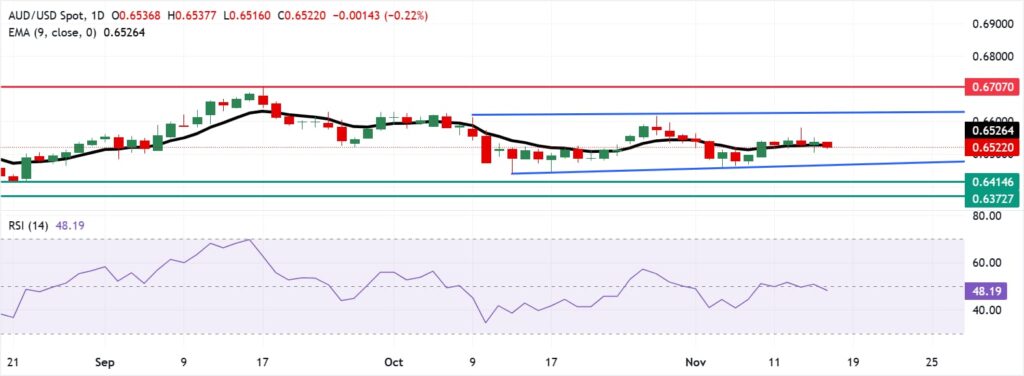
The AUD/USD pair is trading around 0.6520 on Monday. The daily chart shows the pair consolidating within a rectangular range, indicating sideways movement, with the price near the nine-day Exponential Moving Average (EMA), suggesting stabilizing momentum.
The AUD/USD pair may attempt to reach the rectangle’s upper boundary near 0.6630. A decisive break above this level would signal a bullish shift, potentially paving the way for a move toward the 13-month high of 0.6707, last seen on September 17.
On the downside, primary support lies at the lower boundary of the rectangle around 0.6470, followed by the five-month low of 0.6414, recorded on August 21.