

EUR/USD slipped on Wednesday, trading around 1.1670 at its session low after topping 1.1600 on Tuesday. Traders are keeping risk exposure in check during the European session ahead of a crucial US congressional vote to restore government funding and a batch of US economic releases that will shed light on the country’s growth momentum.
Earlier, Germany’s October Harmonized Index of Consumer Prices (HICP) confirmed preliminary estimates, showing inflation steady at 0.3% month-on-month and 2.3% year-on-year—broadly in line with the ECB’s stability target. The German Wholesale Price Index also ticked up 0.3% in October, according to Destatis, reinforcing the ECB’s current monetary stance.
On Tuesday, ADP reported a net loss of 11,250 private-sector jobs in the four weeks through October 25, underscoring weakness in the US labour market and adding pressure on the Federal Reserve to consider rate cuts in December. That data weighed on the dollar ahead of Wednesday’s lineup of Fed speakers and European central bank commentary.
In the remainder of Wednesday’s calendar, ECB Vice President Luis de Guindos and board member Isabel Schnabel will speak in Frankfurt, while several Fed officials are scheduled to comment in the US, likely touching on recent labour figures and the Fed’s rate path.
Daily market takeaway: The US dollar is mildly bearish this week as investors anticipate that forthcoming data will compel Fed officials to prioritize job growth over inflation, cementing bets on a December rate cut. The euro has benefited from the dollar’s pullback.
Key data summary:
- Germany’s HICP rose 0.3% in October and 2.3% year-on-year, slightly below September’s 2.4%.
- German CPI matched a 0.3% monthly gain, with annual inflation easing to 2.3% from 2.4%.
- Germany’s wholesale prices advanced 0.3% in October (vs. 0.2% in September), beating forecasts of 0.1%, though the annual rate slipped to 1.1% from 1.2%.
- US ADP’s four-week average showed private payrolls fell by 11,250 jobs per week through October 25, bolstering expectations for Fed dovishness.
- Germany’s ZEW survey disappointed: the economic sentiment index dropped to 38.5 in November (from 39.3 in October; expected 40), and the current conditions reading improved only to –78.7 (vs. –80 and the expected –77.5).
Technical Analysis: EUR/USD nears trendline resistance around 1.1615.
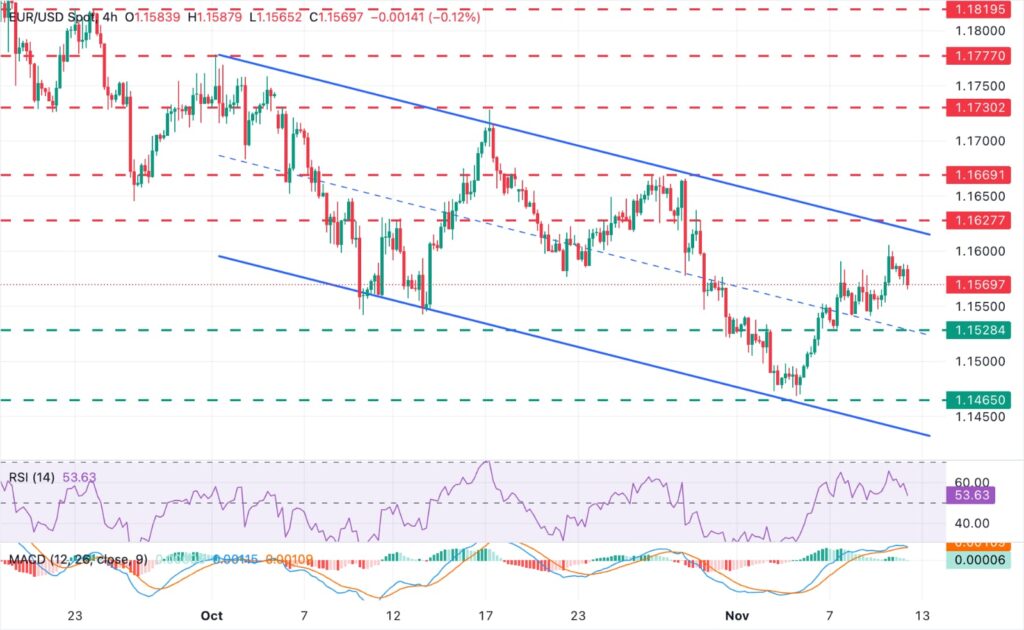
EUR/USD 4-Hour Chart
Over the past five days, EUR/USD has steadily climbed. On the 4-hour chart, the RSI sits near 60 and the MACD histogram is printing green bars, both signaling continued upside potential. That said, upside momentum could stall around the 1.1600 area.
The price is now testing the upper boundary of the October descending channel, roughly at 1.1615, which coincides with previous support in the 1.1620–1.1625 zone (October 28 low). A clear break above these levels would invalidate the broader downtrend and shift focus toward the October 28–29 highs near 1.1670.
On the downside, the pair has found short-term support around the session low of 1.1575. Further declines could be supported in the 1.1530–1.1540 area (November 7 and 10 lows), ahead of the 1.1500 psychological level and the November 5 low at about 1.1470.